Beginner's Guide to Yoga Asana: 140 Poses, and the One Question Every Single One Is Actually Asking
What asana actually tests before it's ever a shape to copy, the complete map of all 140 poses across seven families, and the first five explained in full, taught exactly the way they're taught in class.
Noble Srinivasan
Founder, Muladhara Yoga Wellness
Somewhere along the way, asana turned into a photograph. A shape you copy off a screen, hold for the camera, and post. That was never what the word meant, and it is not what I teach. An asana is a test. Gravity is pulling on your body right now, in whatever position you are reading this in, and every single asana asks the same underlying question in a different shape: can you find the point where your body's weight and the ground's pull actually agree with each other? That agreement is called equilibrium, and the moment your body finds it, the pose is attained. Not when your hand touches your foot. Not when your leg goes straight. When the equilibrium is real.
I teach this online to people from Dubai to the United States to Scotland to Japan, which in practice means my working day runs from about three in the morning to eight at night, because somewhere in that stretch, it is a reasonable hour for someone on the other side of the planet to step onto their mat. Different bodies, different time zones, different reasons for showing up. What I watch for is the same in every single one of them: the gravitational flow through the posture, whether the person is actually present enough to feel where their own equilibrium is sitting, or whether they are just performing a shape they saw somewhere.
The idea underneath every asana on this page
Here is the short version of something I usually spend a full class explaining. Every asana has an architecture, a structure built for a specific purpose. That structure is the yantra. Whether your actual felt experience, in your actual body, matches the path that structure is built to create, that recognition is the tantra. And when that match is confirmed, when you test it and the energy genuinely connects, that is the mantra of the pose. Only then is the asana actually attained, not merely performed.
Take Padahastasana, hand to foot pose, as the clearest example. Fold forward and let your palms come to the ground. A flexible person falls forward with the legs collapsing to get there. A stiff person gets stuck halfway, hunching the middle back to force it. But nobody is purely stiff and nobody is purely flexible, that framing is already the wrong question. The real question is whether your palms can actually carry the energy your feet are sending them. There is a real perception available here, the same perception that eventually becomes a handstand: a tiny fraction of your strength is what's actually trying to lift your feet off the ground, and your entire bodyweight can rest through your palms without your shoulders feeling stress, because the equilibrium point is doing the work, not your shoulder muscles bracing against it. That equilibrium sits at the sacrum, the root core, drawing the energy from your feet, through the ground, into your palms. That transaction, feet to palm, is the reason the pose is named Padahastasana in the first place.
Every asana below is interconnected the same way. This is exactly how sequences like Surya Namaskara and vinyasa flow eventually get built: not as choreography to memorize, but as individual grounding points strung together once each one is actually understood on its own.
The rule this guide is built around
To start understanding how energy actually moves through the body, a beginner needs only three minimum asanas in each grounding category, not dozens. Standing is the base of the whole system: the feet meet the ground first, and from there the practice either delivers that contact up through the palms and out through the fingertips toward the sky, or gathers it back inward through a gesture like pranam. Until that exchange is actually created and initiated at the base, no energy is allowed to move toward the crown. That is the first rule of practicing asana, and it is exactly why presence, actually being aware of yourself while you practice, matters more here than anywhere else.
Sitting works with multiple grounding methods, not only the feet. Poses like Malasana, Ustrasana, and Vajrasana bring the awareness down through the tips of the toes and into the shin muscles, a deeper awareness that keeps the joints from ever having to suffer once the muscle channel and the nerve channel are actually understood. Where there is understanding, there is no pain. It becomes an experience: endurance, strength, learning, evolution.
Every angle after that, prone, supine, twisting, balancing, is about testing that same equilibrium from a new direction. Awareness to be present, communication with the body, regulating and educating the mind, bringing mind and body into a union that is friendly and submissive toward the self being present. That is when the yantra is seen, the tantra is recognized, the mantra is initiated, and evolution begins.
How to use this guide
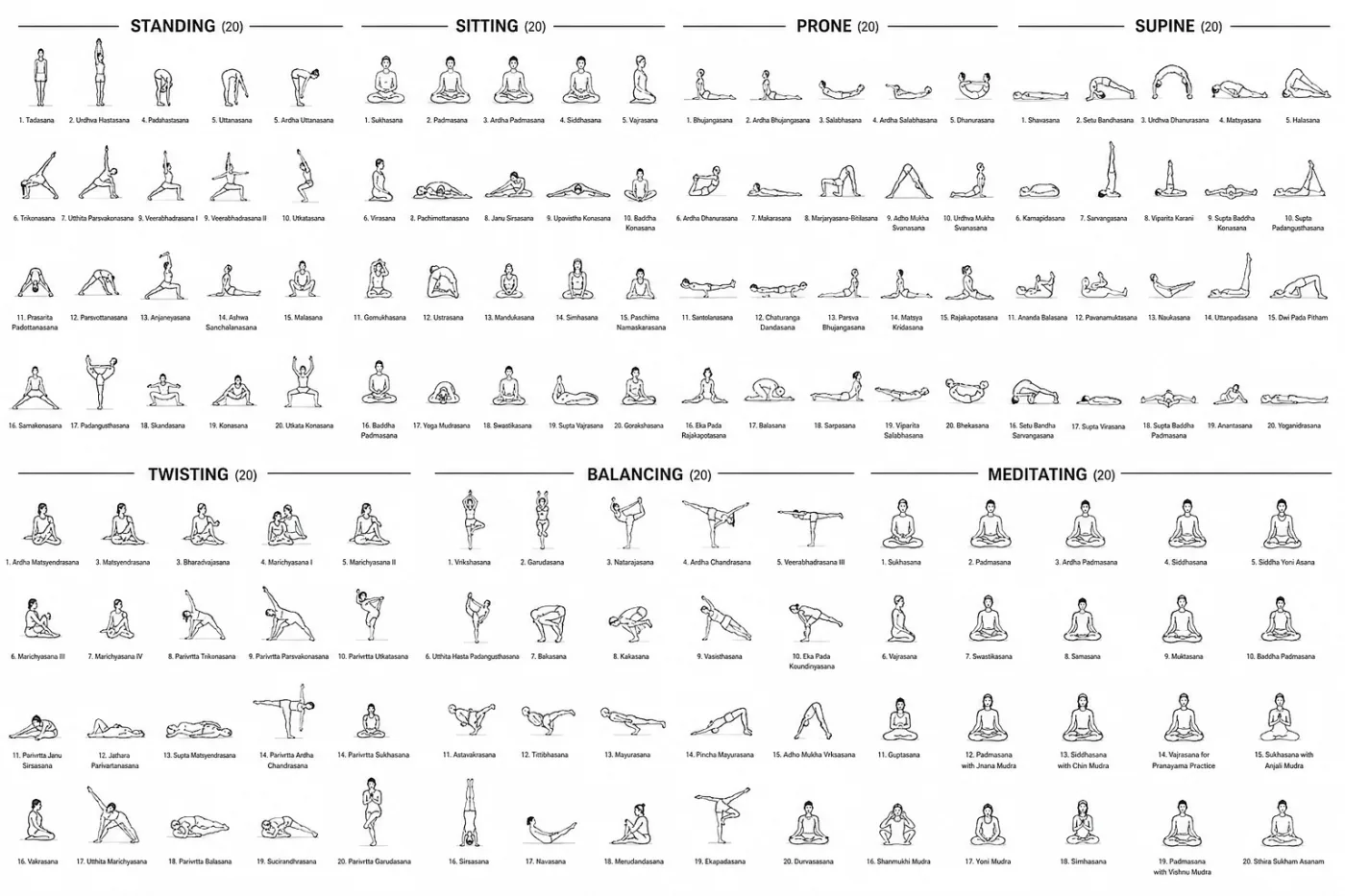
There are 140 asanas catalogued below, organized into the seven families you'll see in the chart and the lists that follow: Standing, Sitting, Prone, Supine, Twisting, Balancing, and Meditating. Every single name is listed here, with what it means. Five poses from each family are getting the full treatment, their own page, written the way I'd actually teach them in a class: the meaning of the name, how I cue it, the precaution and contraindication, the applied science and the gravity and equilibrium underneath it, connected back to the tantra, yantra, and mantra of that specific pose. Those five per family are linked below as they go live, one new page published roughly every day so this guide keeps growing rather than sitting still. The rest of the 140 are named here so you have the real map of what exists, with the full depth on each of them arriving as the book, the companion app, and future posts get released.
Standing Asanas (20)
- Tadasana (Mountain Pose)
- Urdhva Hastasana (Upward Salute)
- Padahastasana (Hand-to-Foot Pose)
- Uttanasana (Standing Forward Fold)
- Ardha Uttanasana (Half Standing Forward Fold)
- Trikonasana (Triangle Pose)
- Utthita Parsvakonasana (Extended Side Angle Pose)
- Veerabhadrasana I (Warrior I)
- Veerabhadrasana II (Warrior II)
- Utkatasana (Chair Pose)
- Prasarita Padottanasana (Wide-Legged Forward Fold)
- Parsvottanasana (Pyramid Pose)
- Anjaneyasana (Crescent Lunge)
- Ashwa Sanchalanasana (Low Lunge)
- Malasana (Garland Pose)
- Samakonasana (Straight Angle Pose)
- Padangusthasana (Big Toe Pose)
- Skandasana (Side Lunge Pose)
- Konasana (Angle Pose)
- Utkata Konasana (Goddess Pose)
Sitting Asanas (20)
- Sukhasana (Easy Pose)
- Padmasana (Lotus Pose)
- Ardha Padmasana (Half Lotus)
- Siddhasana (Accomplished Pose)
- Vajrasana (Thunderbolt Pose)
- Virasana (Hero Pose)
- Pachimottanasana (Seated Forward Fold)
- Janu Sirsasana (Head-to-Knee Pose)
- Upavistha Konasana (Wide-Angle Seated Forward Fold)
- Baddha Konasana (Bound Angle Pose)
- Gomukhasana (Cow Face Pose)
- Ustrasana (Camel Pose)
- Mandukasana (Frog Pose)
- Simhasana (Lion Pose)
- Paschima Namaskarasana (Reverse Prayer Pose)
- Baddha Padmasana (Bound Lotus)
- Yoga Mudrasana (Seal of Yoga Pose)
- Swastikasana (Auspicious Pose)
- Supta Vajrasana (Sleeping Thunderbolt Pose)
- Gorakshasana (Cowherd's Pose)
Prone Asanas (20)
- Bhujangasana (Cobra Pose)
- Ardha Bhujangasana (Sphinx Pose)
- Salabhasana (Locust Pose)
- Ardha Salabhasana (Half Locust)
- Dhanurasana (Bow Pose)
- Ardha Dhanurasana (Half Bow)
- Makarasana (Crocodile Pose)
- Marjaryasana-Bitilasana (Cat-Cow Pose)
- Adho Mukha Svanasana (Downward Facing Dog)
- Urdhva Mukha Svanasana (Upward Facing Dog)
- Santolanasana (Plank Pose)
- Chaturanga Dandasana (Four-Limbed Staff Pose)
- Parsva Bhujangasana (Side Cobra)
- Matsya Kridasana (Flapping Fish Pose)
- Rajakapotasana (King Pigeon Pose)
- Eka Pada Rajakapotasana (One-Legged King Pigeon)
- Balasana (Child's Pose)
- Sarpasana (Advanced Cobra)
- Viparita Salabhasana (Reverse Locust)
- Bhekasana (Frog Backbend)
Supine Asanas (20)
- Shavasana (Corpse Pose)
- Setu Bandhasana (Bridge Pose)
- Urdhva Dhanurasana (Wheel Pose)
- Matsyasana (Fish Pose)
- Halasana (Plough Pose)
- Karnapidasana (Ear Pressure Pose)
- Sarvangasana (Shoulder Stand)
- Viparita Karani (Legs-Up-the-Wall Pose)
- Supta Baddha Konasana (Reclining Bound Angle)
- Supta Padangusthasana (Reclining Big Toe Pose)
- Ananda Balasana (Happy Baby Pose)
- Pavanamuktasana (Wind-Relieving Pose)
- Naukasana (Boat Pose)
- Uttanpadasana (Elevated Leg Pose)
- Dwi Pada Pitham (Two-Footed Tabletop)
- Setu Bandha Sarvangasana (Supported Shoulder Bridge)
- Supta Virasana (Reclining Hero Pose)
- Supta Baddha Padmasana (Reclining Bound Lotus)
- Anantasana (Vishnu's Couch Pose)
- Yoganidrasana (Yogic Sleep Pose)
Twisting Asanas (20)
- Ardha Matsyendrasana (Half Lord of the Fishes)
- Matsyendrasana (Full Lord of the Fishes)
- Bharadvajasana (Bharadvaja's Twist)
- Marichyasana I (Sage Marichi's Pose I)
- Marichyasana II
- Marichyasana III
- Marichyasana IV
- Parivrtta Trikonasana (Revolved Triangle)
- Parivrtta Parsvakonasana (Revolved Side Angle)
- Parivrtta Utkatasana (Revolved Chair)
- Parivrtta Janu Sirsasana (Revolved Head-to-Knee)
- Jathara Parivartanasana (Reclining Belly Twist)
- Supta Matsyendrasana (Supine Spinal Twist)
- Parivrtta Ardha Chandrasana (Revolved Half Moon)
- Parivrtta Sukhasana (Simple Seated Twist)
- Vakrasana (Simple Spinal Twist)
- Utthita Marichyasana (Standing Twist Variant)
- Parivrtta Balasana (Revolved Child's Pose)
- Sucirandhrasana (Thread the Needle Pose)
- Parivrtta Garudasana (Revolved Eagle)
Balancing Asanas (20)
- Vrikshasana (Tree Pose)
- Garudasana (Eagle Pose)
- Natarajasana (Lord of the Dance Pose)
- Ardha Chandrasana (Half Moon Pose)
- Veerabhadrasana III (Warrior III)
- Utthita Hasta Padangusthasana (Extended Hand-to-Big-Toe Pose)
- Bakasana (Crow Pose)
- Kakasana (Crane Pose)
- Vasisthasana (Side Plank Pose)
- Eka Pada Koundinyasana (Sage Koundinya's Pose)
- Astavakrasana (Eight-Angle Pose)
- Tittibhasana (Firefly Pose)
- Mayurasana (Peacock Pose)
- Pincha Mayurasana (Forearm Stand)
- Adho Mukha Vrksasana (Handstand)
- Sirsasana (Headstand)
- Navasana (Boat Pose)
- Merudandasana (Spine of Mount Meru Pose)
- Ekapadasana (One-Legged Standing Pose)
- Durvasasana (Sage Durvasa's Pose)
Meditating Asanas (20)
This family shares its base postures with Sitting on purpose. A seated pose only actually becomes a mudra once its yantra is built from precise points with an understood purpose, that understanding is the tantra, and once that's real, the mantra can be stimulated toward whatever's actually being sought: silence, visualization, concentration, or decluttering. Every yantra holds more than one arena. The pages below read each pose's name through that lens, then connect what it's pointing at to real, modern physics, so the mechanism is as clear as the meaning.
- Sukhasana (Easy Pose)
- Padmasana (Full Lotus)
- Ardha Padmasana (Half Lotus)
- Siddhasana (Accomplished Pose)
- Siddha Yoni Asana (feminine equivalent of Siddhasana)
- Vajrasana (Thunderbolt Pose)
- Swastikasana (Auspicious Pose)
- Samasana (Balanced Pose)
- Muktasana (Free Pose)
- Baddha Padmasana (Bound Lotus)
- Guptasana (Hidden Pose)
- Padmasana with Jnana Mudra
- Siddhasana with Chin Mudra
- Vajrasana for Pranayama Practice
- Sukhasana with Anjali Mudra
- Shanmukhi Mudra (seated sense-withdrawal practice)
- Yoni Mudra (seated practice)
- Simhasana (Lion Pose, used meditatively)
- Padmasana with Vishnu Mudra (for Nadi Shodhana)
- Sthira Sukham Asanam (Patanjali's own definition of asana: the steady, comfortable seat)
The book and the app
The full book and companion app, with all 140 asanas explained in this same depth, are under construction. I'm working to get the science and the mysticism behind each pose right, the applied anatomy and the gravity and equilibrium of it, so that it's actually useful to the people learning it, not just accurate on paper. It's coming. Until then, this guide grows one pose at a time.
Before you go
If this guide helped you understand a pose better, drop a comment and let us know what you felt. If you enjoyed it, share it with someone in your circle who's learning too, it helps more people find the right insight. And if you want to go deeper before the book and app are ready, reach out directly. We're here for the support.
What did you think?
Be the first to share your thoughts
More to Read
Why the Hands Matter as Much as the Legs in a Meditation Seat
Sep 23, 2026
Sitting in Easy Pose and Actually Meditating in It Are Not the Same Thing
Sep 22, 2026
Boat Pose Is Not an Ab Exercise Wearing a Sanskrit Name
Sep 21, 2026
Half Moon Pose Is Triangle Pose With the Floor Taken Away
Sep 20, 2026
This Pose Is Named After a Cosmic Dancer, and the Balance Point Is the Whole Metaphor
Sep 19, 2026
Eagle Pose Wraps Your Limbs Around Each Other, and That Is the Entire Point
Sep 18, 2026
0 Comments
Share your thoughts. Comments are reviewed before appearing.
Leave a Comment