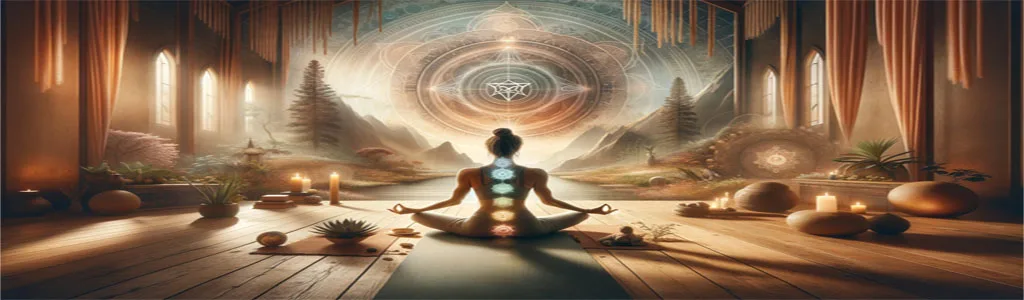
Why the Hands Matter as Much as the Legs in a Meditation Seat
Jnana Mudra closes a small, deliberate circuit in an otherwise open hand. Here's the closed-loop physics behind the gesture of knowledge, paired with Padmasana's pyramid.
Noble Srinivasan
Founder, Muladhara Yoga Wellness
The hands matter as much as the legs in a meditation seat, and that claim is easy to dismiss until it's actually tried.
What the name is actually telling you
Padmasana is the pyramid seat covered in its own page in this guide, three grounded joints, sacrum and both knees, rising to a single shared apex at the forehead and crown, with energy understood to rise from the center of that triangular base and mature inside the field the pyramid creates. Jnana mudra means the gesture of knowledge, thumb and index finger joined into a closed ring, the remaining three fingers extended.
How to actually do it
Once settled in Padmasana, or a more accessible cross-legged seat if the hips aren't ready for full lotus, never force the legs to access the hands, rest the backs of the hands on the knees. Join the thumb tip to the index fingertip, letting the other three fingers extend naturally, not stiffly. Palms can face up, for a more receptive quality, or down, for a more grounded one, both are traditionally used.
A closed loop versus an open line
A closed loop is a closed circuit, current sustains itself continuously around it. An open line only radiates outward and dissipates. Knowledge, jnana, isn't information broadcast outward until it scatters, it's the moment a channel completes into a loop and can hold itself. The three fingers left open keep exchanging with the world the way they always do, this one specific loop, thumb to index, is sealed on purpose, a small, deliberate circuit closed inside a much larger, open hand.
Precaution and contraindication
Never force the legs into full Padmasana to access this mudra, a simpler cross-legged seat carries the mudra just as well while the hips need more time. Standard Padmasana knee cautions apply if attempting the full leg position.
The science involved
The hand carries an unusually dense concentration of nerve endings for its size, and holding a specific, sustained position there sends a small, continuous instruction along those pathways for the entire duration of the sit, disproportionate in effect relative to how little physical effort it takes. Pairing that stable, closed-circuit hand position with the pyramid's own stable base gives the mind two small, constant structural anchors to return to whenever attention drifts during the sit.
This is one of the first five Meditating poses in the Beginner's Guide to Yoga Asana. Build the hip readiness for the full seat with Padmasana first.
If this helped, drop a comment and let us know what you felt. Share it with someone in your circle who's learning too. And if you want to go deeper before the book and app are ready, reach out directly, we're here for the support.
What did you think?
Be the first to share your thoughts
More to Read
The Only Definition of a Yoga Pose That Actually Matters, According to Patanjali Himself
Sep 26, 2026
The Practice Where You Close Every Gate to the Outside World on Purpose
Sep 25, 2026
The One Seat That Will Not Fight You While You Are Trying to Breathe
Sep 24, 2026
Sitting in Easy Pose and Actually Meditating in It Are Not the Same Thing
Sep 22, 2026
Boat Pose Is Not an Ab Exercise Wearing a Sanskrit Name
Sep 21, 2026
Half Moon Pose Is Triangle Pose With the Floor Taken Away
Sep 20, 2026
0 Comments
Share your thoughts. Comments are reviewed before appearing.
Leave a Comment