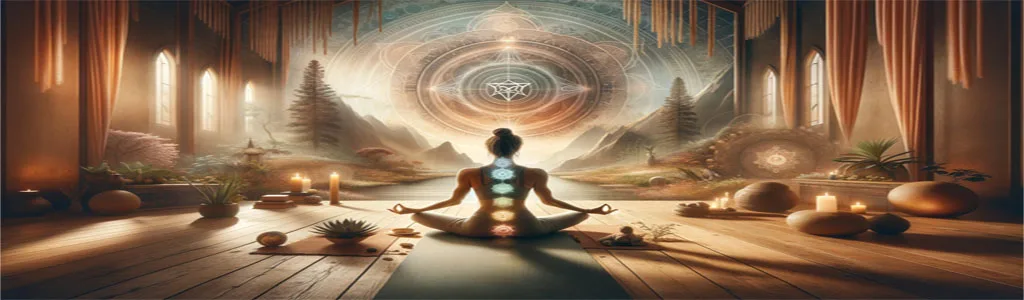
Sitting in Easy Pose and Actually Meditating in It Are Not the Same Thing
Sukhasana's ease is structural, not spiritual, a wide base of support needs far less correction than a narrow one. Here's the physics behind the pose called Easy.
Noble Srinivasan
Founder, Muladhara Yoga Wellness
Sitting in Easy Pose and actually meditating in it are not automatically the same activity, even though the legs are folded exactly the same way for both. Something changes between the two, and it isn't the shape.
What the name is actually telling you
Sukha means ease, but the ease isn't a spiritual instruction floating free of the body, it's built into the geometry. Padmasana's three grounded joints, the sacrum and both knees, converge to a single apex, a narrow, tall pyramid. Sukhasana's base is the opposite shape entirely: the sit bones and both shins laid flat along the ground, a wide, low platform instead of a tapered point.
The physics of ease
A wider base of support gives the body's center of mass far more room to shift before the structure actually tips, which is exactly why this seat asks for so little active correction to hold. That's not a metaphor, it's the same principle underneath why a low, wide table is harder to knock over than a tall, narrow one. Ease, in this pose, is a real structural advantage a wide foundation has over a precise, narrow one, not the absence of effort.
Where the meditation seat actually begins
The physical setup carries over from the general seated version of this pose: hips elevated on a cushion if needed so they sit above the knees, sit bones grounded evenly, spine long without gripping to hold that length, shoulders soft. Once settled, the instruction shifts. Close the eyes, or soften the gaze downward a few feet in front. Rest the hands in the lap or on the knees, in whichever mudra the practice calls for. Then, critically, stop adjusting. The physical refinement phase ends, and the sitting-still phase begins, once the wide, stable base stops needing conscious correction, the attention it was spending on balance becomes available for whatever the meditation itself is asking for.
Precaution and contraindication
Same as the general Sukhasana entry: use a cushion under the hips whenever the knees sit higher than the hips, and alternate which shin crosses in front from one sit to the next.
The science involved
Sustained, minimally-adjusted stillness measurably lowers sympathetic nervous system activity over time, distinct from the actively-corrected stillness of a posture still being learned. A wider physical base of support genuinely reduces how much ongoing muscular correction is needed to maintain it, which is part of the actual mechanism, not just the feeling, behind why this seat settles into stillness faster than a more structurally demanding one.
This is one of the first five Meditating poses in the Beginner's Guide to Yoga Asana. See the Sitting-segment version of Sukhasana for the full physical setup this page builds on.
If this helped, drop a comment and let us know what you felt. Share it with someone in your circle who's learning too. And if you want to go deeper before the book and app are ready, reach out directly, we're here for the support.
What did you think?
Be the first to share your thoughts
More to Read
The Only Definition of a Yoga Pose That Actually Matters, According to Patanjali Himself
Sep 26, 2026
The Practice Where You Close Every Gate to the Outside World on Purpose
Sep 25, 2026
The One Seat That Will Not Fight You While You Are Trying to Breathe
Sep 24, 2026
Why the Hands Matter as Much as the Legs in a Meditation Seat
Sep 23, 2026
Boat Pose Is Not an Ab Exercise Wearing a Sanskrit Name
Sep 21, 2026
Half Moon Pose Is Triangle Pose With the Floor Taken Away
Sep 20, 2026
0 Comments
Share your thoughts. Comments are reviewed before appearing.
Leave a Comment