The Seven Emotions Living Inside You, and What They Are Trying to Tell You: Part 2
Feeling better is not the same as getting better. Part two shows how to actually cool down, release labels that were never yours, forgive without carrying it, and let your body do what it already knows how to do.
Noble Srinivasan
Founder, Muladhara Yoga Wellness
This is Part 2. If you have not read how the seven emotions actually connect to your organs, interact with each other, and spread between people, start with Part 1 first.
← Start from Part 1The Emotions That Break You Can Also Build You
The body is not merely damaged by emotion.
Emotion can also become a training ground.
A person who learns to:
- recognize anger
- tolerate fear
- process grief
- stop unnecessary rumination
- experience joy without clinging
- recover after shock
- communicate appropriately
- establish boundaries
- forgive without forgetting the lesson
can become more:
- conscious
- resilient
- productive
- adaptable
- emotionally intelligent
- physically regulated
- socially effective
The objective is therefore not:
"Remove all negative emotions."
It is:
"Become capable of experiencing the full emotional range without losing internal balance."
Feeling Better Is Not the Same as Getting Better
This distinction is extremely important.
A person may feel better after:
- travelling
- laughing
- meeting a friend
- exercising
- sleeping
- changing surroundings
- distracting the mind
- taking a break
That relief is valuable.
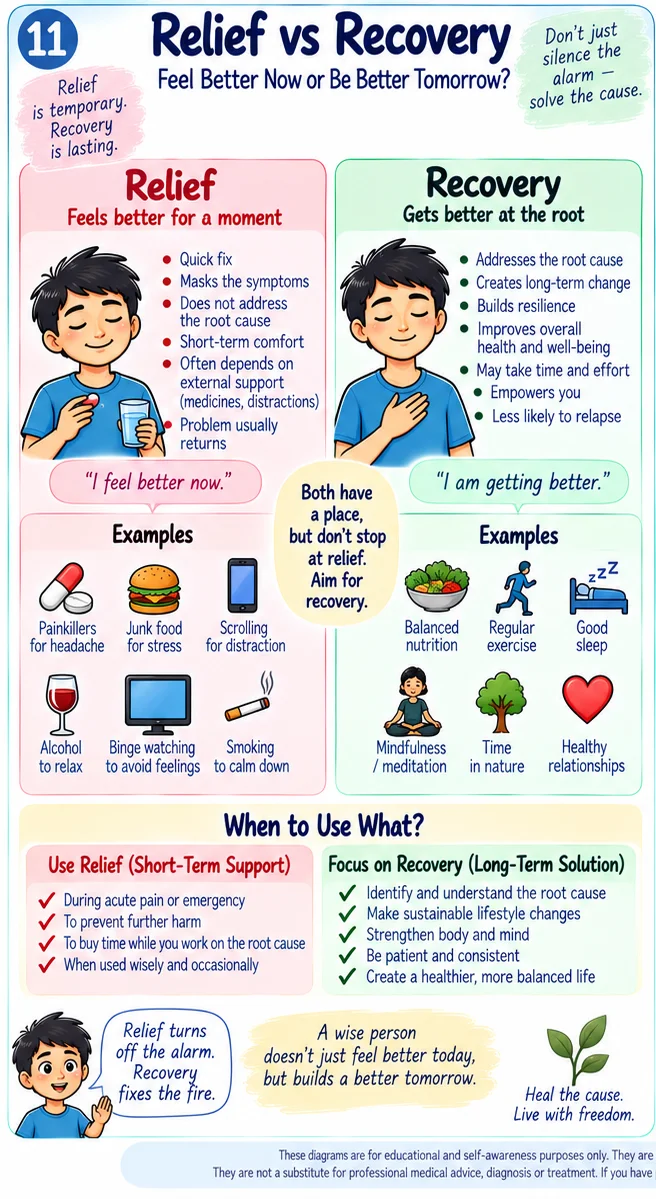
But relief does not automatically mean the underlying problem has been resolved.
Sometimes relief simply gives the system enough breathing space to begin resolving the deeper issue.
Therefore:
Relief → space
Awareness → understanding
Appropriate action → resolution
Repeated healthy regulation → recovery
Cool Down Before You Say a Word You Cannot Take Back
One of the most practical principles of this entire study is:
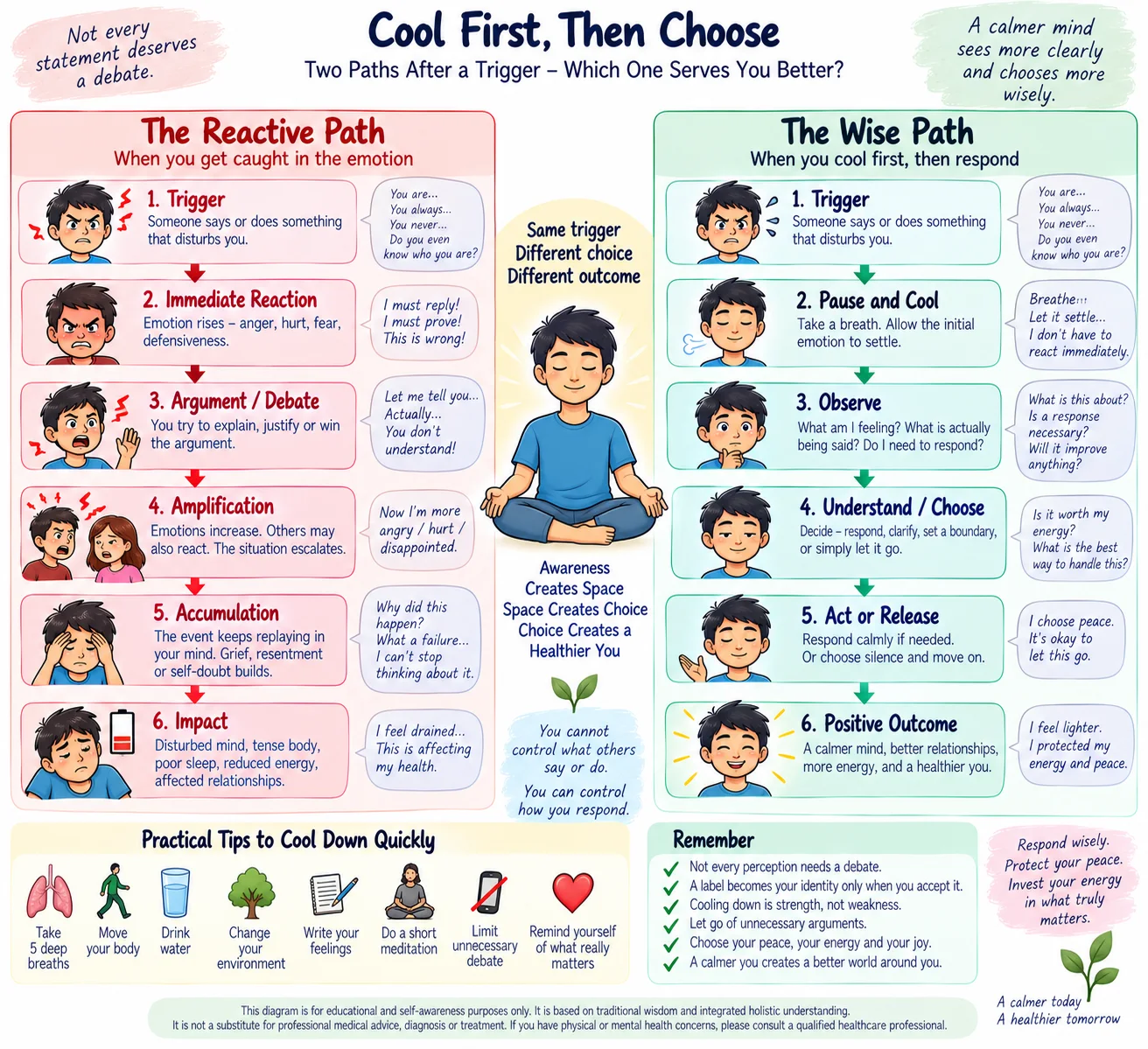
Whatever the reason that caused the emotional imbalance, first work on cooling it off.
Do not immediately debate.
Do not immediately prove yourself.
Do not immediately identify the villain.
Do not immediately identify yourself as the victim.
Do not accumulate grief over your perception of failure.
First lower the emotional temperature.
Then investigate.
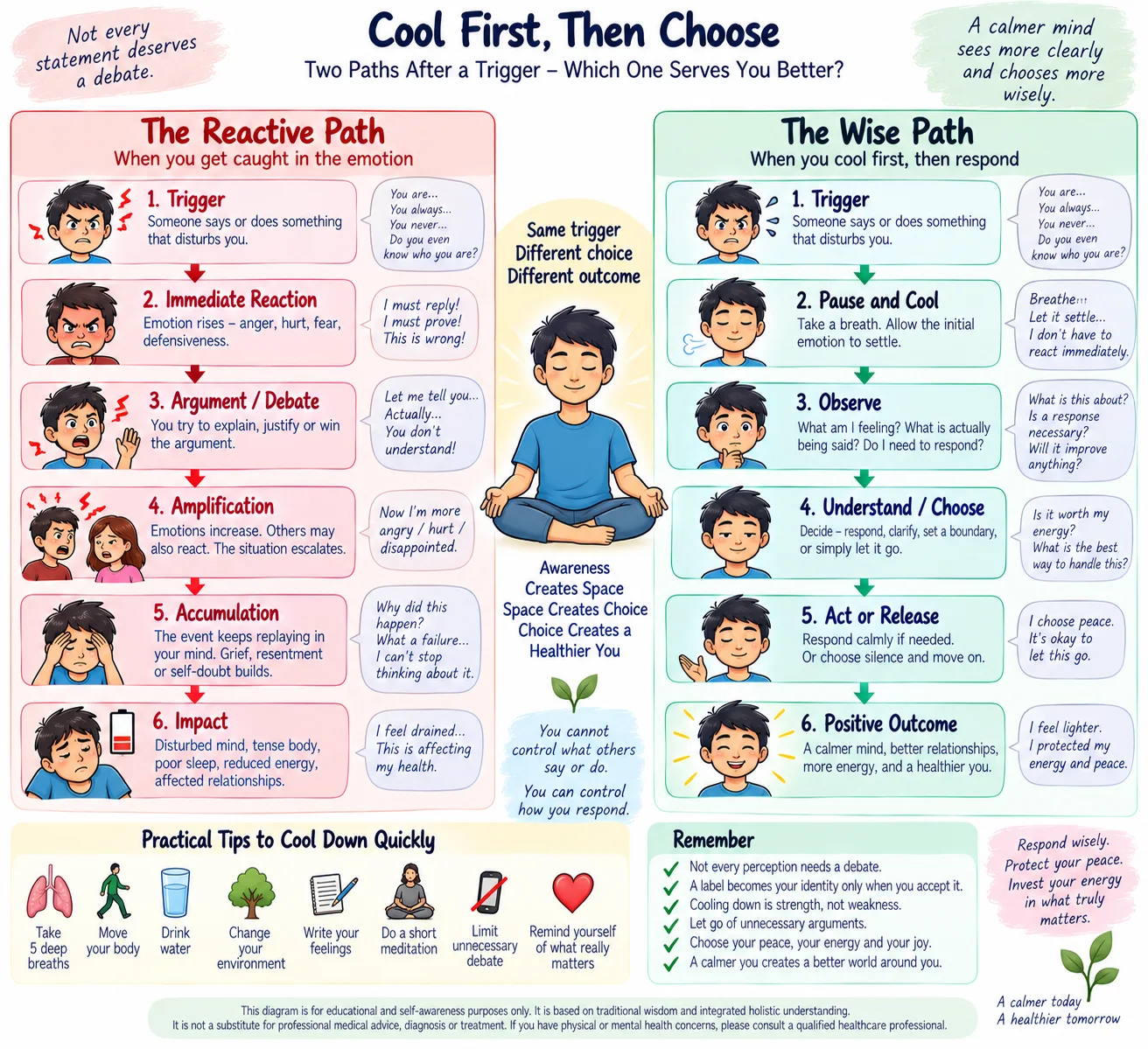
This can be summarized as:
Cool → Observe → Understand → Decide → Act or Release
Not:
Trigger → React → Debate → Accumulate → Identify → Suffer
Not Every Opinion About You Deserves Your Energy
There is an old practical wisdom:
Do not argue with a fool.
The useful interpretation is not that other people are beneath us.
It is:
"Not every statement deserves our emotional energy."
Someone may say:
"You are unsuccessful."
"You are selfish."
"You are incapable."
"You are not intelligent."
"You should be this."
"You should have done that."
You do not have to accept the statement.
But you also do not have to fight it.
Sometimes:
"Okay."
is enough.
Then move on.
The statement can remain with the person who produced it.
Stop Wearing the Labels Other People Hand You
Other people can give you labels.
They may put a badge on you:
successful / unsuccessful
good / bad
strong / weak
intelligent / foolish
beautiful / unattractive
winner / loser
But a label becomes part of your identity only when you accept ownership of it.
What others call you does not automatically define who you are.
If someone tries to turn:
"Do you know who you are?"
into an endless debate, you can simply decline the debate.
Forgive them.
Release the argument.
Move on.
Not because every criticism is false, but because you do not need every person's perception to become part of your internal world.

Forgiveness Is Not for Them, It Is for the Space Inside You
Forgiveness does not necessarily mean:
- approving what happened
- forgetting what happened
- trusting the person again
- removing boundaries
- allowing the same behaviour again
Forgiveness can simply mean:
"I will no longer allow this event to consume unnecessary space inside me."
A boundary may remain.
The lesson may remain.
The memory may remain.
But the emotional charge can gradually decrease.
That is a different form of freedom.
Sometimes the Fastest Fix Is Simply Leaving the Room
When someone is deeply down, repeatedly asking them to analyze the problem may sometimes make things worse.
If thinking itself has become difficult:
change the environment.
Meet someone positive.
Go somewhere peaceful.
Walk.
Spend time in nature.
Practice Yoga.
Breathe.
Listen to music.
Do something creative.
Talk to a healthy and trustworthy person.
Give the mind a different input.
This is not necessarily running away from the problem.
It can be a method of interrupting the feedback loop.
The mind needs breathing space before it can analyze accurately.
Your Body Is Talking, Are You Actually Listening
The body constantly provides information.
It communicates through:
- appetite
- thirst
- sleep
- breathing
- bowel function
- urination
- muscle tension
- energy
- pain
- temperature
- fatigue
- movement
- heart rate
- emotional changes
These signals should not automatically be interpreted as a diagnosis.
Instead:
Listen first. Interpret second. Intervene third.
This prevents one of the most dangerous loops:
symptom → theory → self-diagnosis → confirmation → anxiety → more symptoms → stronger confirmation.
Awareness should increase clarity, not create another source of fear.
Four Ancient Systems, One Same Truth
Different traditions provide different maps.
TCM
Can provide perspectives through:
- Qi
- Blood
- Yin-Yang
- Zang-Fu relationships
- meridians
- Shen
- emotional correspondences
- pattern differentiation
Yoga
Can provide tools involving:
- breath
- asana
- meditation
- pratyahara
- concentration
- self-observation
- nervous-system regulation
- awareness of habitual reactions
Ayurveda
Can provide perspectives involving:
- dosha balance
- agni
- ojas
- manas
- sattva, rajas and tamas
- lifestyle
- food
- daily routine
Naturopathy
Can emphasize:
- nature
- nutrition
- sleep
- sunlight
- movement
- breathing
- hydrotherapy
- elimination
- lifestyle correction
- whole-person observation
These systems should not be artificially declared identical.
Their concepts can be placed side by side and compared, while preserving the original meaning of each tradition.
The Hidden Formula Behind Every Emotional Recovery
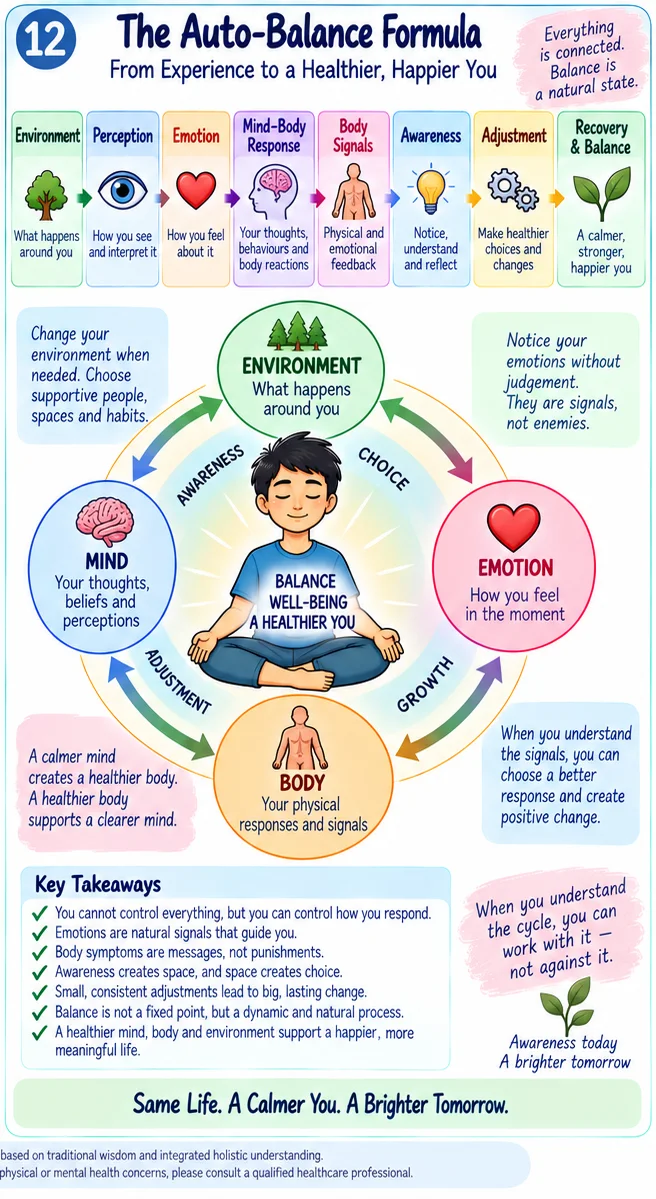
A useful working model is:
Environment
↓
Perception
↓
Emotion
↓
Mind-body response
↓
Behaviour
↓
Body signals
↓
Awareness
↓
Adjustment
↓
Recovery
And the process repeats.
The healthier the regulation, the shorter the harmful loop can become.
Your Body Already Knows How to Heal, Stop Getting in Its Way
The body possesses remarkable regulatory intelligence.
When supported appropriately, many physiological systems continuously attempt to restore balance.
This includes:
- temperature regulation
- fluid balance
- blood pressure regulation
- glucose regulation
- immune regulation
- tissue repair
- sleep-wake regulation
- autonomic adjustment
Emotion interacts with this regulatory environment.
Therefore, the practical goal is not to force the body into health.
It is often to remove unnecessary obstacles and provide conditions in which regulation can occur.
This gives us a useful philosophy:
Do not always ask, "What should I force the body to do?" Also ask, "What is preventing the body from doing what it already knows how to do?"
Can Feeling Good Actually Heal You?
Healthy emotional states can support health through many pathways.
Calmness may reduce unnecessary stress activation.
Joy may increase social connection and motivation.
Hope may improve engagement with healthy behaviour.
Acceptance may reduce repetitive psychological struggle.
Confidence may increase productive action.
Good relationships may provide emotional and practical support.
But we should remain precise:
Healthy emotion can support the conditions for healing; it should not be presented as a guaranteed cure for physical disease.
Some illnesses require diagnosis, medication, surgery, rehabilitation or other medical treatment.
Emotional balance can be complementary to those processes rather than a replacement for them.
Twelve Things I Want You to Actually Do
1. Do not react at the peak of emotion.
Cool yourself first.
2. Do not make every statement a debate.
Ask:
"Does answering this actually improve my life?"
If not, let it pass.
3. Do not wear somebody else's badge.
Their perception is theirs.
Your identity requires deeper examination.
4. Do not accumulate grief over failure.
Learn from the event.
Do not repeatedly punish yourself with the same story.
5. Change the environment when necessary.
Sometimes the mind needs a new input before it can process the old one.
6. Choose the people around you carefully.
A healthy, cheerful, trustworthy person can sometimes provide a mirror that you cannot provide for yourself while emotionally disturbed.
7. Observe the body.
Ask:
- What changed?
- When did it change?
- What was happening around that time?
- What improves it?
- What worsens it?
- Is the pattern repeating?
8. Do not diagnose yourself too quickly.
Observation is not diagnosis.
A theory is not proof.
A correlation is not automatically causation.
9. Allow emotions to move.
Do not glorify suppression.
Do not glorify uncontrolled expression either.
Learn appropriate expression, processing and release.
10. Learn to tolerate emotional discomfort.
Growth does not mean never feeling fear, anger or grief.
It means becoming less frightened by your own emotional landscape.
11. Protect your joy.
Do not make your joy dependent on everyone's approval.
12. Master the whole emotional spectrum.
The goal is not to become permanently happy.
The goal is to become capable of remaining conscious while experiencing happiness, sadness, fear, anger, grief, excitement and uncertainty.
Own Your Joy: The Principle That Ties Everything Together
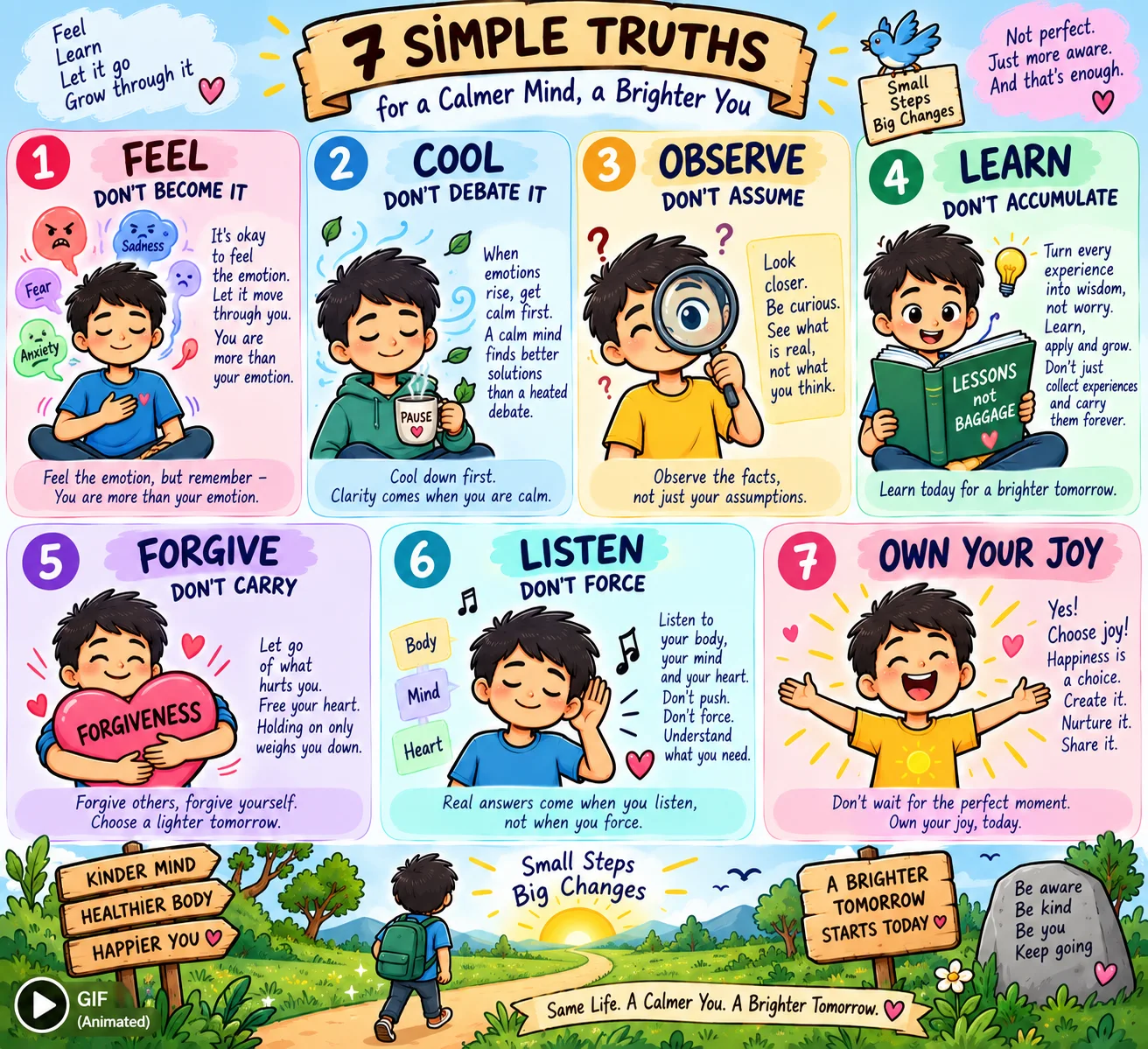
Perhaps the entire study can ultimately be reduced to this:
Feel the emotion, but do not surrender your identity to it.
Understand the signal, but do not immediately turn it into a diagnosis.
Investigate the cause, but do not endlessly debate the cause.
Learn from failure, but do not accumulate grief around it.
Protect yourself, but do not build your entire world around fear.
Forgive, but maintain appropriate boundaries.
Change your environment when the environment is disturbing your regulation.
Listen to the body before interfering with it.
And above all:
If you own your joy, you can begin creating the world you want. But to truly own your joy, you must learn to experience and master the rest of your emotions without hesitation, suppression or haste.
The mature state is not:
"I have no negative emotions."
It is:
"Whatever emotion comes, I can meet it without losing myself."
That is emotional balance.
That is conscious living.
And perhaps that is where the relationship between mind, emotion, body and healing becomes most meaningful.
What did you think?
Be the first to share your thoughts
More to Read

The Only Definition of a Yoga Pose That Actually Matters, According to Patanjali Himself
Sep 26, 2026
The Practice Where You Close Every Gate to the Outside World on Purpose
Sep 25, 2026
The One Seat That Will Not Fight You While You Are Trying to Breathe
Sep 24, 2026
Why the Hands Matter as Much as the Legs in a Meditation Seat
Sep 23, 2026
Sitting in Easy Pose and Actually Meditating in It Are Not the Same Thing
Sep 22, 2026
Boat Pose Is Not an Ab Exercise Wearing a Sanskrit Name
Sep 21, 2026
0 Comments
Share your thoughts. Comments are reviewed before appearing.
Leave a Comment