The Seven Emotions Living Inside You, and What They Are Trying to Tell You: Part 1
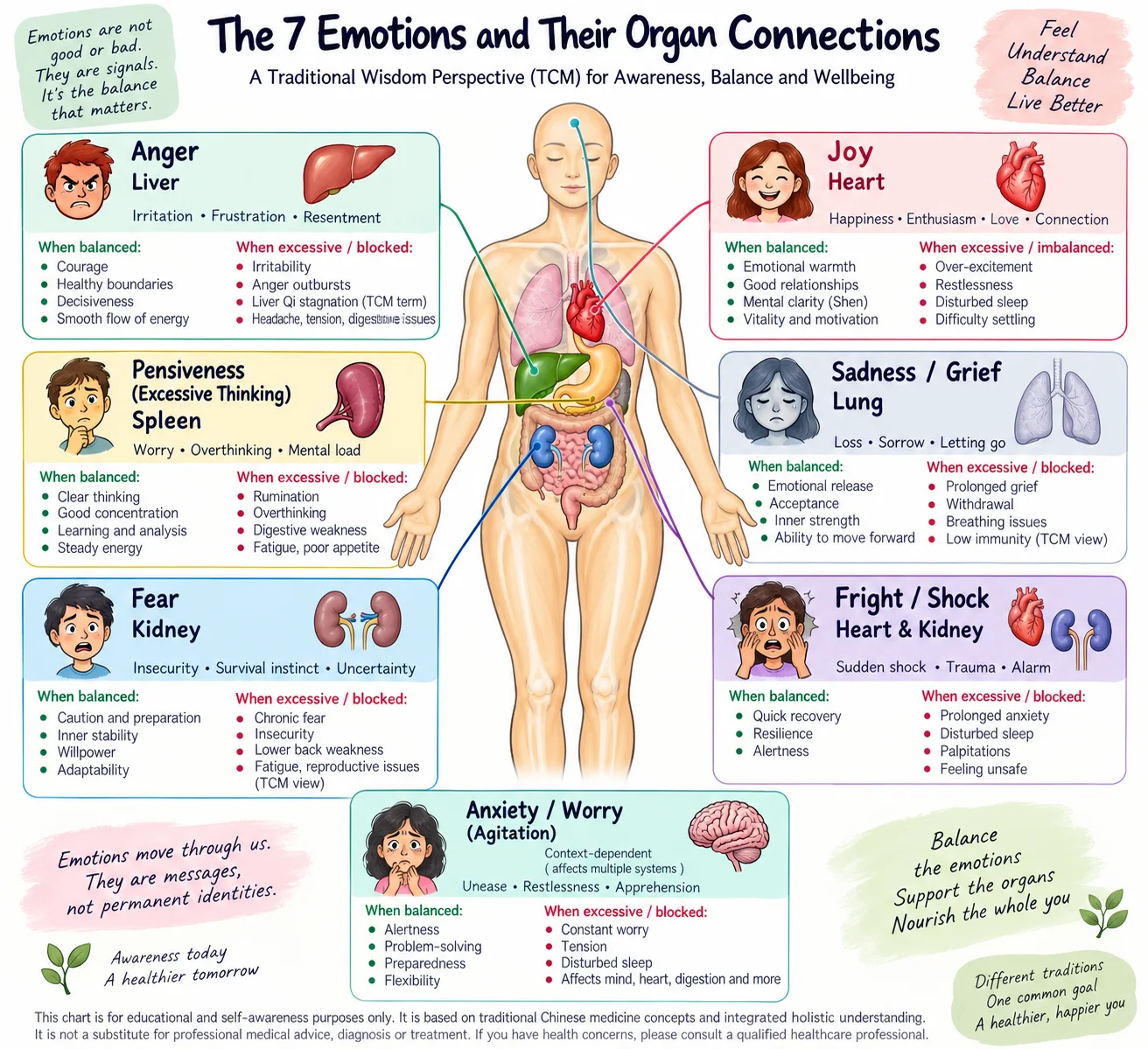
Anger lives in the liver, fear in the kidneys, grief in the lungs. This is how the seven emotions actually move through your organs, your mind and the people around you, before you try to fix anything.
Noble Srinivasan
Founder, Muladhara Yoga Wellness
Stop Blaming One Thing for How You Feel
Human beings are not machines in which one symptom always has one cause.
An emotional state may arise from:
- something happening within the body
- something happening in the mind
- another person
- the surrounding environment
- memories and previous experiences
- expectations and disappointment
- prolonged stress
- physical exhaustion
- disturbed sleep, food or lifestyle
- unresolved relationships
- fear of the future
- interpretation of an event
- or a combination of many factors
Therefore, this study begins with one important principle:
Do not corner down an imbalance too quickly.
Do not immediately conclude:
"This emotion caused this organ problem."
And equally, do not conclude:
"This organ is disturbed, therefore I must have this emotion."
Both directions can become traps.
The body, mind, emotions, behaviour and environment continuously influence one another.
The purpose of this study is therefore not to create seven boxes into which every human problem must fit.
It is to learn how to observe the relationship between emotion and the body without losing the larger picture.
The Seven Emotions Hiding Inside Your Organs
In the classical TCM framework, the commonly discussed seven emotions are:
| Emotion | Traditional TCM association |
|---|---|
| Anger | Liver |
| Joy | Heart |
| Pensiveness / excessive thinking | Spleen |
| Sadness / grief | Lung |
| Fear | Kidney |
| Fright / shock | Heart and Kidney |
| Anxiety / worry / agitation* | Context-dependent, overlaps with several systems |
*Different classical texts and modern teaching systems organize the seven emotions somewhat differently. The purpose here is not to force every emotional experience into a single organ.
The important principle is:
An emotion is not simply an organ. An organ is not simply an emotion. The relationship is functional, dynamic and contextual.
The traditional correspondence gives us a map for observation, not a license for automatic diagnosis.
Every Emotion Has a Breaking Point
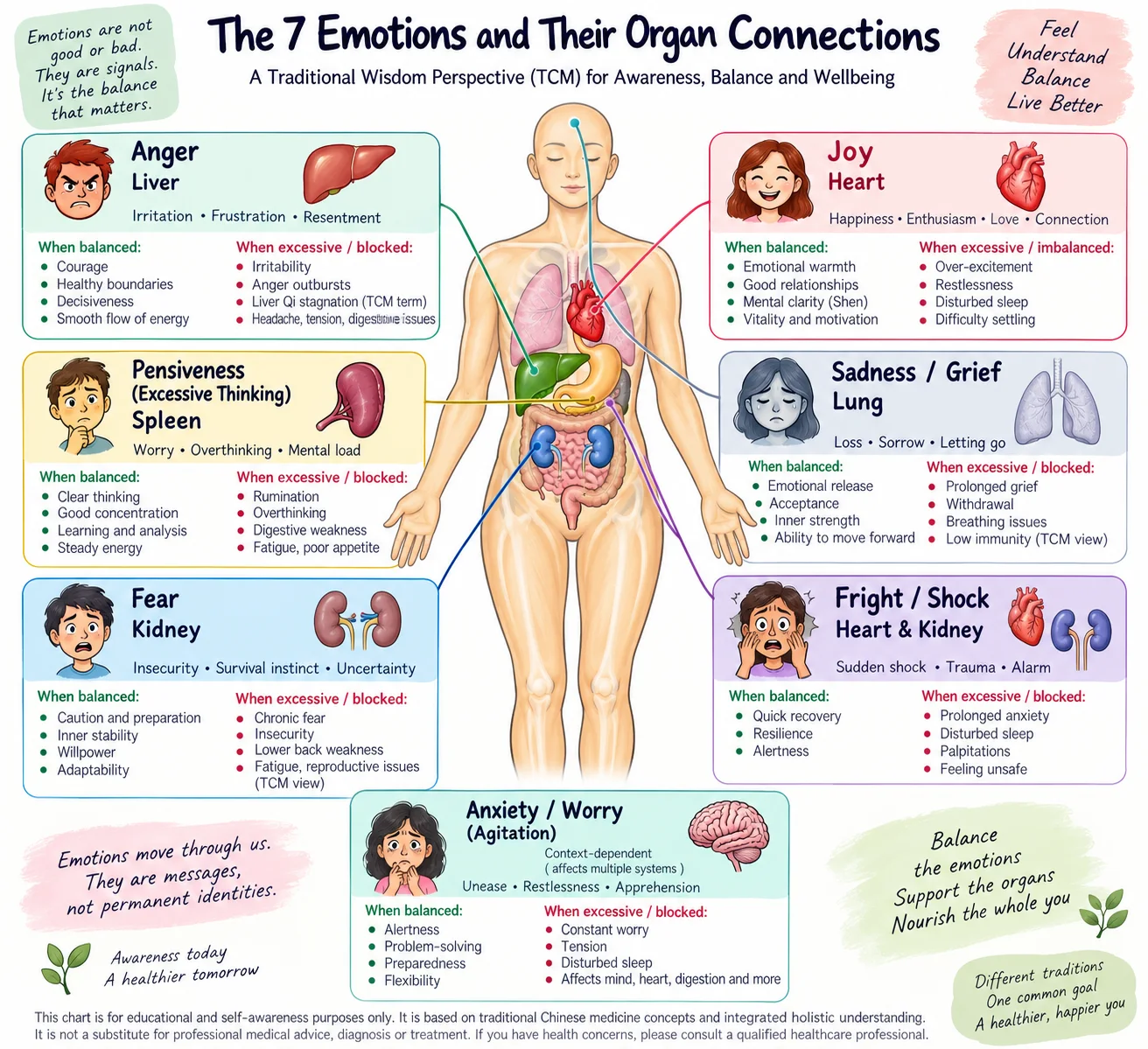
An emotion itself is not necessarily harmful.
The same emotion can have:
healthy expression → useful action → adaptive response
or
excess → suppression → stagnation → dysregulation → functional disturbance.
For example, anger can provide the energy to establish a boundary.
Fear can protect life.
Sadness can allow withdrawal, reflection and grieving.
Joy can connect people.
Thinking can solve problems.
The difficulty begins when the emotional response becomes:
- excessive
- prolonged
- suppressed
- repeatedly triggered
- disconnected from the actual situation
- continuously rehearsed in the mind
- or unable to complete its natural cycle.
Therefore:
The question is not merely "Do I have this emotion?" The better question is "What is this emotion doing, how long has it remained, and what is happening to my body because of it?"
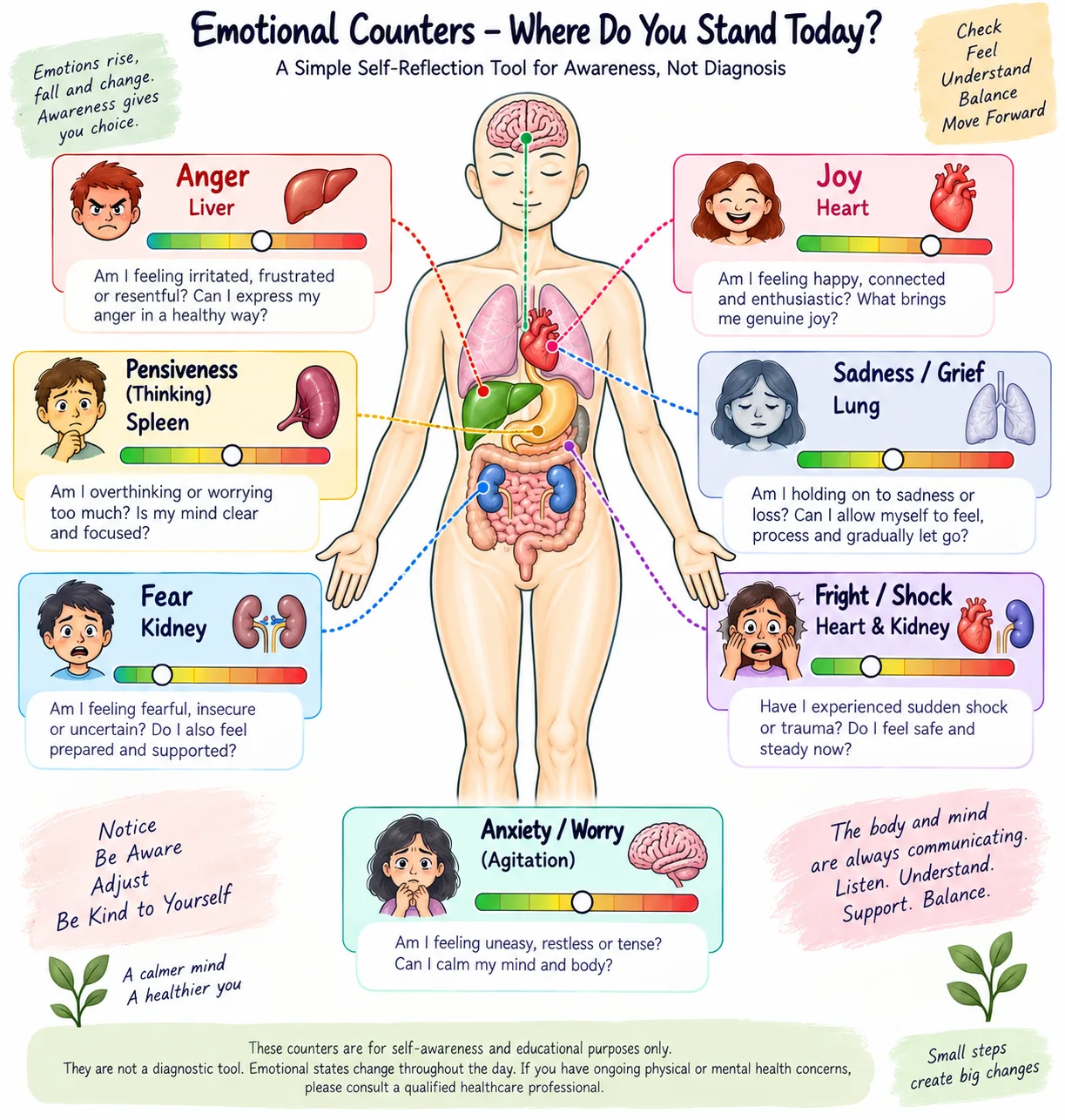
Anger: The Fire That Lives in Your Liver
Healthy range
Anger can provide:
- assertion
- protection
- boundary formation
- courage
- decisive action
- motivation to correct injustice
- the ability to say "No"
A person who can recognize anger without being controlled by it may use it as information.
When it becomes excessive or blocked
Anger may become:
- irritability
- frustration
- resentment
- aggression
- constant argument
- suppressed hostility
- internal pressure
- repeated mental replay of conflicts
In traditional TCM thinking, prolonged emotional constraint is associated with Liver Qi stagnation and, in more developed patterns, potentially other Liver-related disturbances.
The deeper lesson
Anger often asks:
"What boundary has been crossed, what needs to change, or what am I unable to accept?"
But repeatedly debating the same situation does not necessarily resolve the emotion.
Sometimes the first treatment is simply:
Cool it off.
Then decide whether action is actually necessary.
Joy: The Heart's Quiet Superpower
Joy has a special position.
Healthy joy supports:
- connection
- openness
- enthusiasm
- social engagement
- creativity
- emotional resilience
- willingness to participate in life
But even joy has a range.
Excessive excitement, overstimulation or inability to settle can become dysregulating.
The Heart in TCM is also associated with Shen, making this relationship particularly interesting:
Heart ↔ consciousness ↔ emotional expression ↔ relationship with life.
This gives us an important insight:
Joy is not merely an emotion to experience. It can become a state from which the rest of the emotional system is regulated.
But this does not mean that one should force happiness.
Real emotional balance allows joy to exist alongside grief, fear, anger and uncertainty.
Overthinking: When Your Mind Won't Let You Rest
Thinking is essential.
Analysis allows us to:
- understand
- plan
- learn
- solve
- compare
- remember
- make decisions
But thought can become circular.
Instead of:
Think → understand → decide → act
it becomes:
Think → doubt → rethink → analyze → doubt again → repeat.
This is where thought can stop being productive and become a burden.
In traditional TCM, excessive pensiveness is associated with the Spleen.
The practical question is:
Is thinking producing clarity, or is thinking consuming energy without producing movement?
Sometimes the most intelligent action is not another hour of analysis.
It is to change the environment, rest the mind, move the body, speak to someone trustworthy, or simply stop feeding the loop.
Grief: The Weight Your Lungs Carry
Grief has a legitimate function.
Loss requires processing.
Healthy grief can allow:
- acceptance
- emotional release
- withdrawal when necessary
- appreciation
- completion
- gradual reintegration into life
But grief can become accumulated.
A person may repeatedly revisit:
"Why did this happen?"
"Why did I lose?"
"Why wasn't I understood?"
"Why didn't things happen differently?"
The original event may be over, but the mind continues to recreate it.
This is where a distinction becomes essential:
Remembering is not the same as reliving.
Grief should have space to be felt.
But continually accumulating grief over one's perception of failure can become another form of emotional injury.
Fear: The Alarm Your Kidneys Never Stop Ringing
Fear has an obvious biological purpose.
It protects us.
It helps us:
- detect danger
- prepare
- retreat
- conserve resources
- respond quickly
But chronic fear changes the landscape.
The person may begin living in:
"What if?"
rather than:
"What is actually happening now?"
Traditional TCM associates fear with the Kidney system.
From an integrated perspective, persistent fear can also influence:
- autonomic regulation
- sleep
- muscle tension
- breathing
- digestion
- attention
- behaviour
- decision-making
Fear becomes especially damaging when the mind cannot distinguish between:
present danger
and
remembered danger or imagined danger.
Shock: When One Moment Changes Everything
Shock is different from ordinary fear.
Fear can develop gradually.
Fright can be sudden.
A sudden event can produce:
freeze → confusion → hyperarousal → withdrawal → repeated replay.
Traditional TCM discusses fright in relation to the Heart and Kidney systems.
The important observation is that an intense event may continue influencing the nervous system and emotional behaviour long after the immediate event has ended.
This is one reason emotional recovery should not be judged merely by saying:
"The event is over, so you should be fine."
The body and mind may need time to regain regulation.
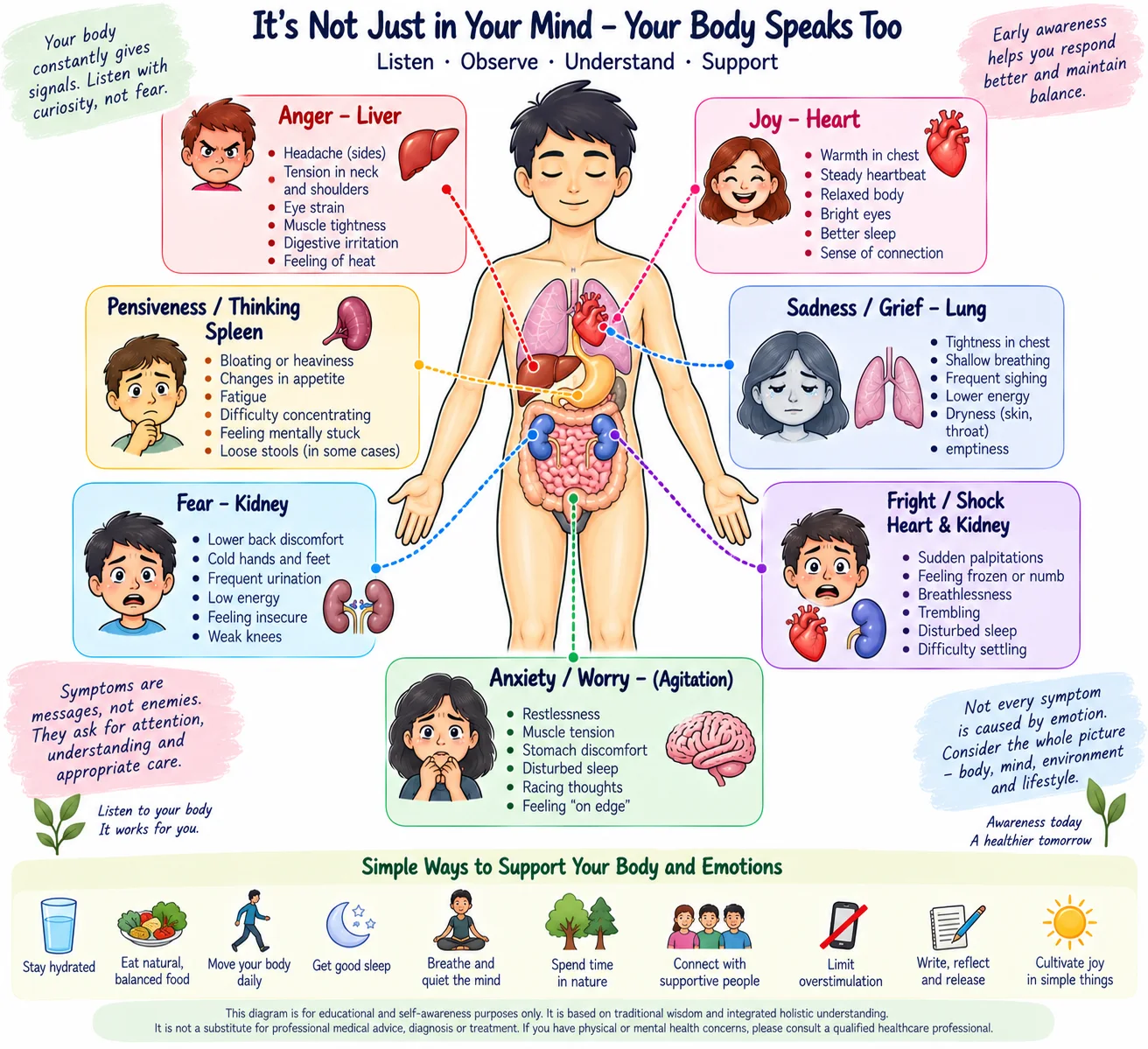
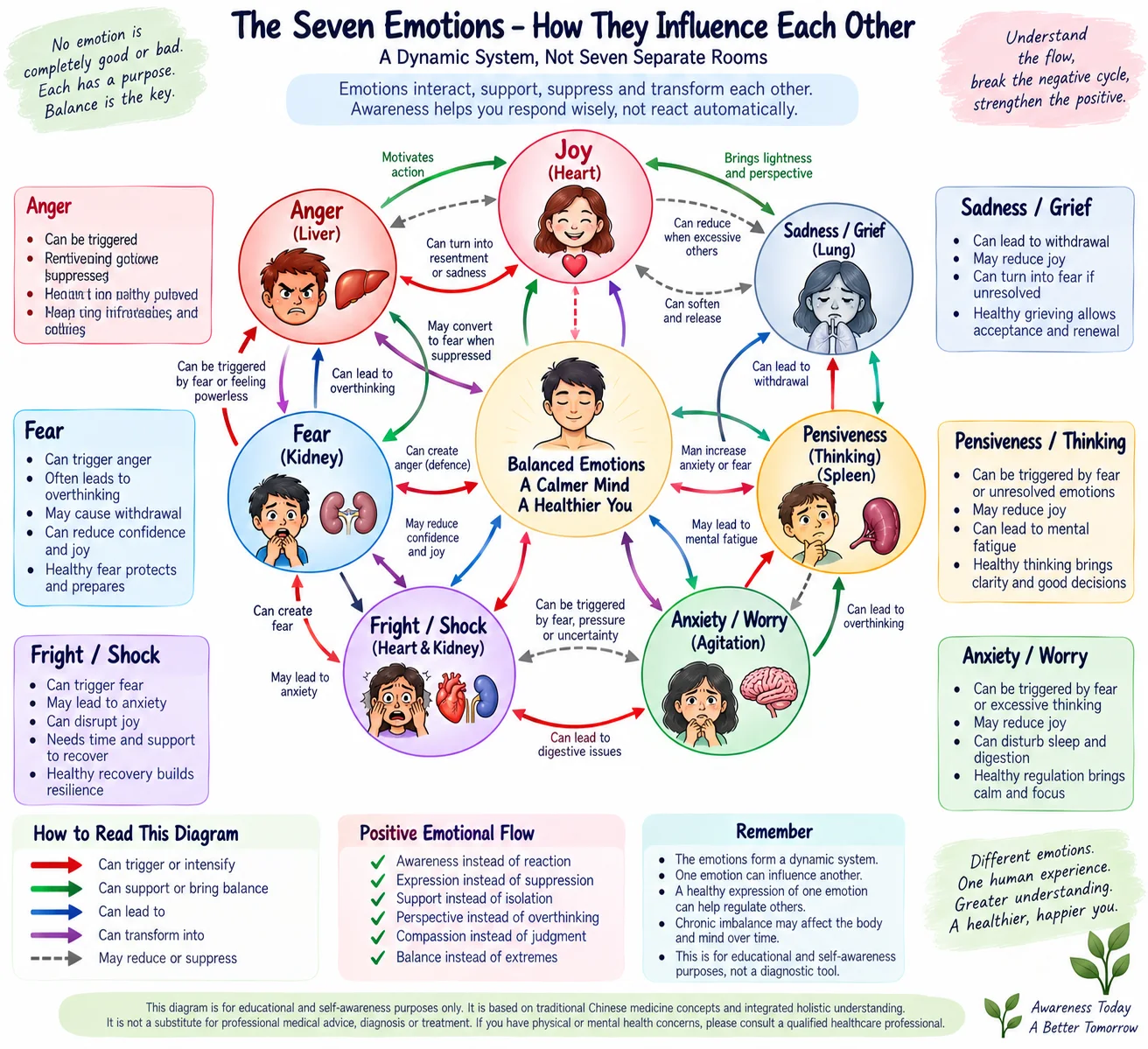
Your Emotions Are Talking to Each Other Behind Your Back
This is where the study becomes more interesting.
The emotions interact.
One emotion can:
- generate another
- suppress another
- amplify another
- compensate for another
- disguise another
- arise because another emotion has been blocked
For example:
Fear → anger
A person who feels powerless may become angry.
Grief → withdrawal → fear
Loss may reduce confidence, which may produce fear about the future.
Fear → excessive thinking
The mind may repeatedly analyze because it is trying to obtain certainty.
Anger → thinking
A person may continuously replay an argument.
Grief → loss of joy
A person may stop participating in life.
Joy → support
Healthy joy can provide emotional space in which difficult emotions become easier to process.
Thus:
The seven emotions form a system, not a list.
Your Mood Is Contagious, Literally
Emotions are not confined to the individual.
Human beings continuously read:
- facial expressions
- voice
- posture
- breathing
- movement
- attention
- tone
- social behaviour
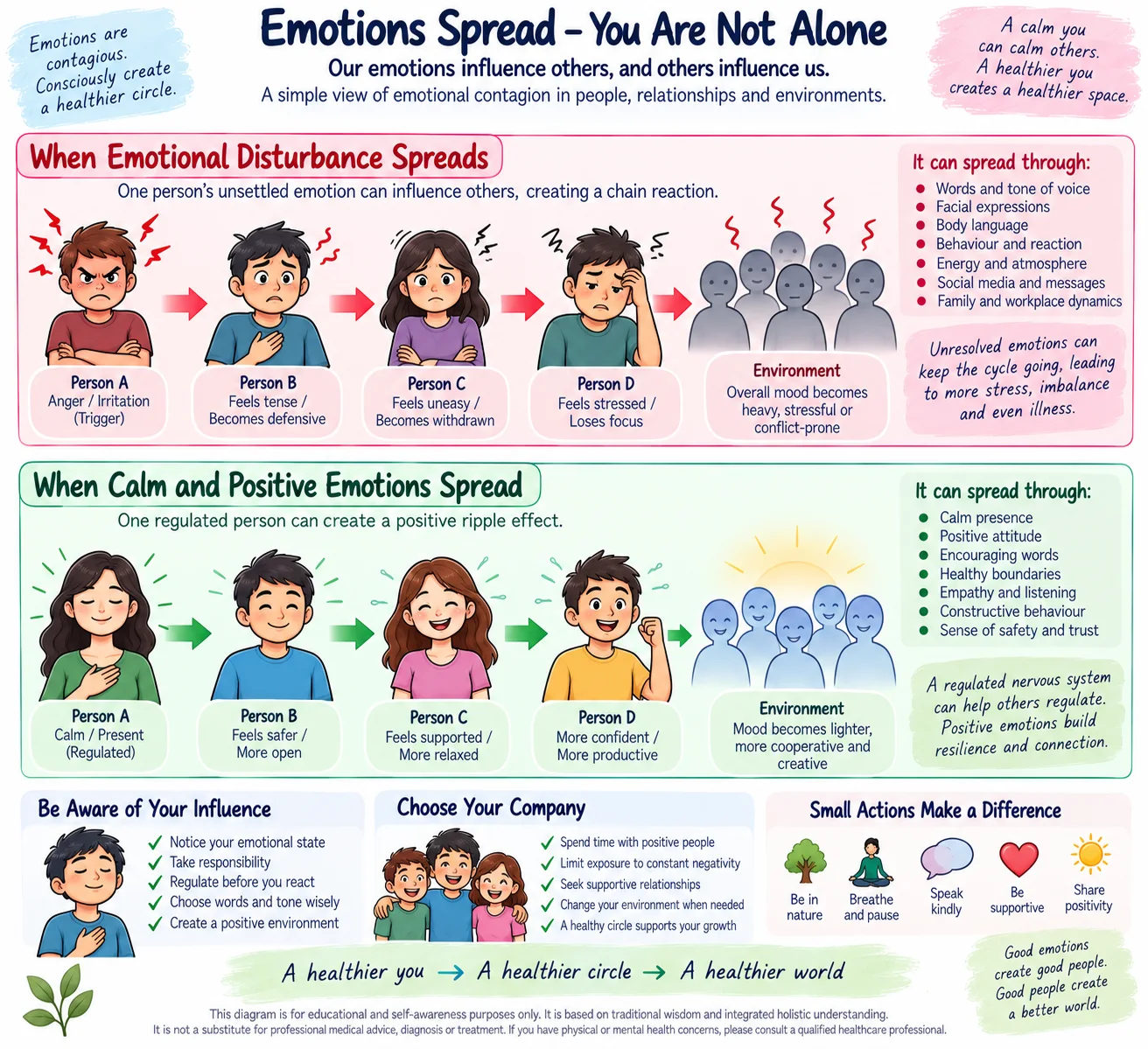
Therefore, emotional states can spread through relationships and environments.
A highly anxious environment can make others tense.
A hostile environment can make others defensive.
A grieving environment can produce heaviness.
A calm and regulated person can sometimes help another person regulate.
This does not mean that one person magically transfers a disease or emotion through an invisible force.
There are many possible mechanisms:
social perception → interpretation → nervous-system response → behaviour → reciprocal response.
This creates a loop.
Example
One person becomes irritated.
↓
Another person senses hostility.
↓
They become defensive.
↓
The first person interprets that defensiveness as disrespect.
↓
They become more angry.
↓
The environment becomes increasingly hostile.
This is an emotional feedback loop.
How One Calm Person Can Change an Entire Room
The same system can work positively.
One person remains calm.
↓
Another person feels less threatened.
↓
Their defensive response decreases.
↓
Communication improves.
↓
The first person becomes even calmer.
↓
The environment becomes safer.
This is why the emotional quality of the people around us matters.
Sometimes changing the environment is not avoidance.
Sometimes it is regulation.
What Actually Happens When an Emotion Gets Stuck
An emotional block does not necessarily mean that an emotion is literally physically stuck inside an organ.
It can mean that an emotional response has become:
- unresolved
- repeatedly activated
- suppressed
- exaggerated
- continuously rehearsed
- disconnected from appropriate action
- or trapped in a feedback loop.
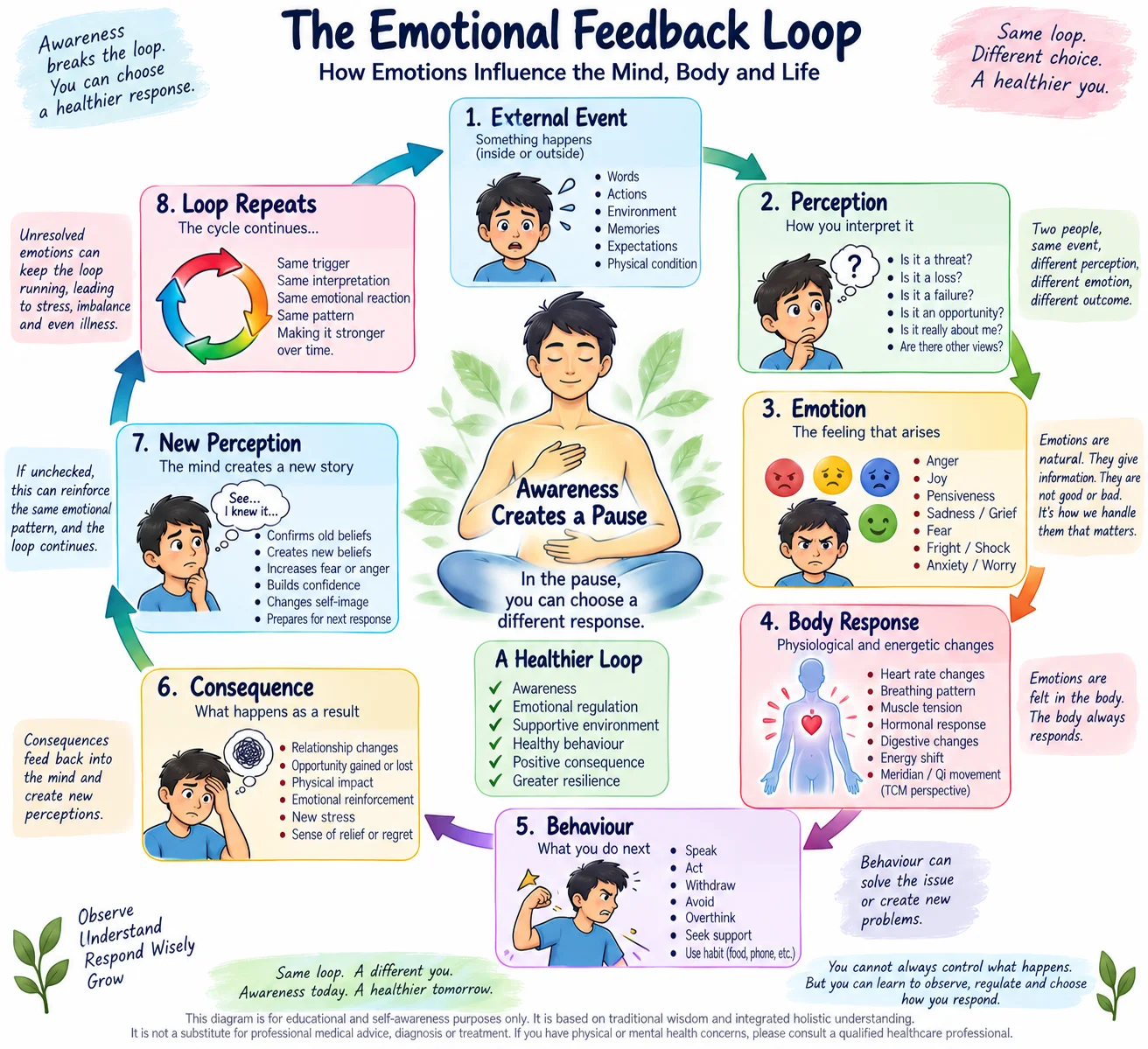
A simplified model is:
Event → perception → emotion → physiological response → behaviour → consequence → new perception
If the loop continues unnecessarily, the system may remain activated.
Over time, this can contribute to:
- poor sleep
- altered appetite
- fatigue
- muscle tension
- digestive disturbance
- autonomic imbalance
- reduced concentration
- emotional exhaustion
- reduced resilience
Persistent stress and emotional dysregulation can also interact with established biological disease processes. However, it would be incorrect to claim that every disease is caused by an emotional block.
That distinction must remain clear.
You've seen how the seven emotions move through your organs, interact with each other, and spread to the people around you. Part 2 is where it becomes practical: how to actually cool down, stop wearing labels that were never yours, forgive without carrying the weight, and let your body do what it already knows how to do.
Continue to Part 2 →What did you think?
1 comment so far
More to Read
The Only Definition of a Yoga Pose That Actually Matters, According to Patanjali Himself
Sep 26, 2026
The Practice Where You Close Every Gate to the Outside World on Purpose
Sep 25, 2026
The One Seat That Will Not Fight You While You Are Trying to Breathe
Sep 24, 2026
Why the Hands Matter as Much as the Legs in a Meditation Seat
Sep 23, 2026
Sitting in Easy Pose and Actually Meditating in It Are Not the Same Thing
Sep 22, 2026
Boat Pose Is Not an Ab Exercise Wearing a Sanskrit Name
Sep 21, 2026
1 Comment
Share your thoughts. Comments are reviewed before appearing.
Very nice. Definitely I will try a session.
Leave a Comment