
You're Not Afraid of Acupuncture, You're Afraid of a Memory From Childhood
Where the fear of acupuncture actually comes from, what really happens in a session, why it's lasted thousands of years anyway, and what the body's 24-hour organ clock reveals about how the body actually works.
Noble Srinivasan
Founder, Muladhara Yoga Wellness
Most people who say they're afraid of acupuncture aren't actually afraid of acupuncture. They're afraid of a memory, usually a vaccination needle from childhood, a moment of being held still while something sharp and unfamiliar happened to your arm, filed away early by the mind as "needle equals danger." That memory has nothing to do with acupuncture itself, but it fires anyway, every time a needle enters the conversation, decades later, in a completely different context. It's worth naming that clearly before anything else, because the fear is real, it's just rarely about the thing people think it's about.
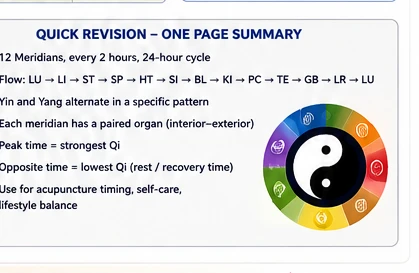
And once that fear is named, there's a much older, bigger idea sitting underneath it that deserves real attention. There is a clock inside you that has nothing to do with the one on your wall. It doesn't ring, it doesn't notify you, and most people go their entire lives without ever meeting it properly. But it runs anyway, on time, every single day, whether you respect it or not. Traditional Chinese Medicine mapped this clock more than two thousand years ago. It calls it the meridian cycle, a 24-hour rhythm where each organ and gland takes its turn holding the body's energy, its Qi, for a two-hour window before passing it forward to the next. Understanding this rhythm, and why acupuncture has survived millennia of change to still be practised today, says something important about how disconnected modern life has become from the body's own logic, and what it might look like to come back into rhythm with it.
Acupuncture Is Older Than Almost Anything We Still Practise Today
It's easy to think of acupuncture as an "alternative" therapy, something new, or trendy, or unproven. It is none of those things. Acupuncture and the meridian system behind it trace back over two thousand years, with roots in Chinese medical texts that predate most of what the modern world considers ancient. Empires have risen and fallen since acupuncture was first practised. Entire medical systems have come and gone. And through all of it, this one has endured, not because of marketing or fashion, but because generation after generation of practitioners and patients kept finding that it worked.
That kind of longevity is rare, and it's worth sitting with for a moment. A therapy doesn't survive several thousand years on placebo and coincidence alone. It survives because it is built on a real, observable understanding of how the body carries and moves energy, tension, and imbalance, refined by centuries of hands-on clinical experience long before anyone had the word "science" to describe what they were doing.
The Fear Isn't Really About the Needle
A lot of people avoid acupuncture for one reason: the needle. But if you trace that fear back, it rarely comes from acupuncture itself. It comes from childhood, from vaccination needles, from a moment of being held down or told to be brave while something sharp and unfamiliar happened to your arm. That fear gets wired in early, and it stays, quietly, waiting to be triggered by anything that looks like a needle.
Here's the part almost nobody tells you: acupuncture needles are nothing like vaccination needles. They're hair-thin, solid rather than hollow, and most people feel little more than a light pressure or a faint tingle, not a "prick" in the way the mind has been trained to expect. And the moment the mind actually experiences this for itself, rather than reacting to the memory of something else, that old fear tends to fall away almost immediately. What's left, once the fear clears, is the actual experience, and it's rarely what people expected. Beyond the needle itself is centuries of study into exactly where the body holds stress, where energy stagnates, and how a precise, minimal intervention can help it move again. That's not a small thing. That's the art and the science both, working together.
The Body Runs on a Cycle, Not a Switch
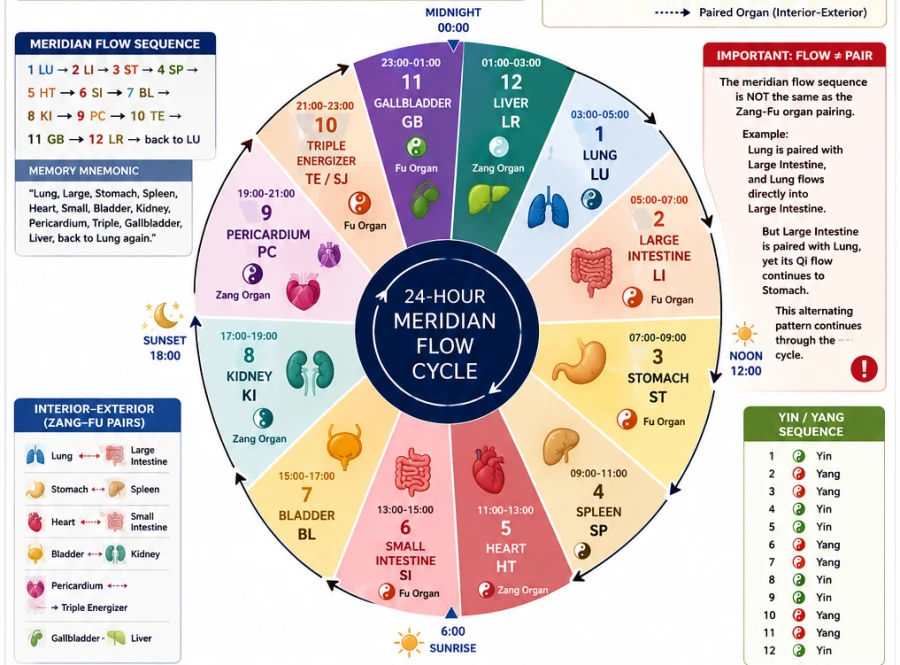
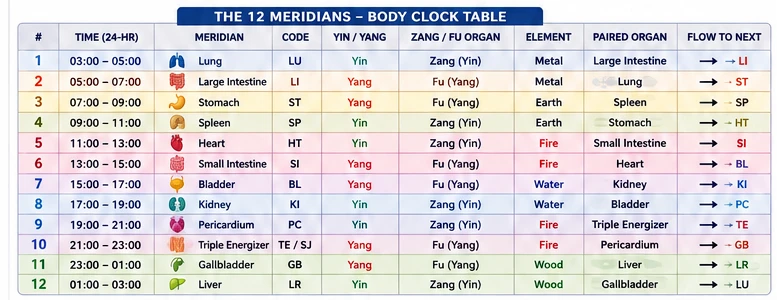
Modern life treats the body like a machine you can run at full output around the clock: work late, eat whenever, sleep when there's time left over, and expect everything to keep functioning the same regardless. But biology was never built to run as one continuous, undifferentiated function. It runs in cycles. Each organ, each gland, has its own window of peak activity and its own window of rest, and the two-hour meridian clock is one of the oldest and most detailed maps of exactly when those windows fall, from the Liver's peak in the early hours of the morning to the Stomach's peak mid-morning to the Heart's peak around midday, and onward through the full 24-hour circuit.
When that cycle is respected, the system runs the way it's designed to. When it isn't, something has to give. Think of it the way a workplace deadline works. One task, delayed past its window, doesn't just disappear, it gets pushed onto whatever comes next in the queue, and that next task now has to carry double the load in the same amount of time. Miss enough deadlines in a row and the whole system backs up, the pressure compounds, and eventually something breaks down or gets rushed and done badly. The body works the same way. When an organ's natural window for repair or activity gets consistently overridden, by late nights, skipped meals, constant stimulation, or stress that never actually resolves, that workload doesn't vanish. It gets carried forward, cycle after cycle, and the pressure accumulates. Every cell downstream inherits a little more of that stress. This is, in a very real sense, exactly what is meant when people talk about the body being "out of balance." It isn't mystical. It's a body running past its own deadlines, over and over, with nowhere for the overdue work to go.
The Body's Low Points Matter Just as Much as Its Peaks
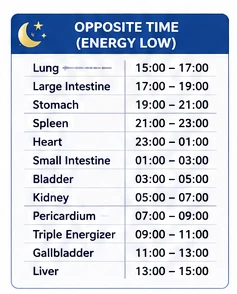
Every organ's two-hour peak has a mirror image: an opposite window, exactly twelve hours later, when that same organ's energy runs lowest. The Lung peaks at 3-5am and dips at 3-5pm. The Heart peaks near midday and dips near midnight. This isn't a flaw in the design, it's built into it on purpose. The low window is when that organ is meant to idle and recover, not perform. Pushing hard exactly when a system is scheduled to rest, forcing focus, exertion, or a heavy meal into that window, is another quiet way the same cumulative pressure builds. Knowing your low points matters just as much as knowing your peaks, arguably more, because it tells you when to actually stop, not only when to start.
What Actually Happens in an Acupuncture Session
Strip away the imagined version and the real one is almost anticlimactic. A session starts with a conversation, your symptoms, your history, what's actually going on, not a script. Then a trained, licensed practitioner places a small number of hair-thin, single-use sterile needles at specific points, and you lie still for somewhere between 20 and 40 minutes. Most people describe the sensation as a faint tingle, a dull warmth, or nothing at all beyond a light pressure at insertion. It's common to feel deeply relaxed, and just as common to fall asleep on the table. That's the entire event the mind spent years bracing against.
This is also why the fear rarely survives a first real session. Fear needs distance to survive, a memory to run on, an imagined version to defend against. The moment it's replaced with an actual, lived experience, calm and largely uneventful, it usually has nowhere left to hide. People who avoided acupuncture for years, sometimes decades, over the needle question routinely say the same thing afterward: that was it?
What Modern Science Is Only Now Catching Up To
Traditional Chinese Medicine described the effects of acupuncture qualitatively, in terms of Qi, meridians, and energetic balance, long before anyone had the instruments to look at what was actually happening in the nervous system, the fascia, or the body's own pain-modulation pathways. That gap in vocabulary is often mistaken for a gap in validity. It isn't. Modern research into how the nervous system and connective tissue respond to precise, localised stimulation is increasingly finding physiological explanations for effects that TCM practitioners documented empirically, through direct clinical observation across generations, centuries before anyone could explain the mechanism in those terms. The ancient framework wasn't guessing. It was building a working, practical map from what actually happened at the needle, one patient and one generation at a time, well before modern science had caught up enough to describe why.
For Anyone Who Wants to Go Deeper
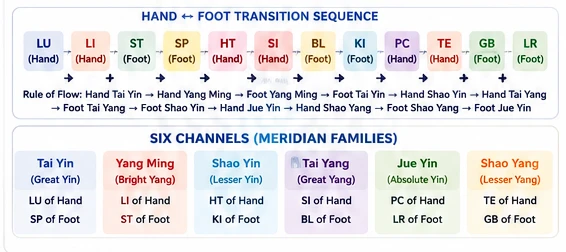
TCM doesn't stop at twelve organs and their timing. Each meridian belongs to a wider family, grouped by whether it runs through the hand or the foot, and by six broader channel pairs, Tai Yin, Yang Ming, Shao Yin, Tai Yang, Jue Yin, and Shao Yang, that describe how energy transitions from one region of the body to the next. None of this needs to be memorised to benefit from the practice. It's simply worth knowing that behind the simple hour-by-hour clock sits a genuinely sophisticated, internally consistent system, refined over thousands of years of clinical observation, not a loose collection of folk sayings.
Whether the fear was ever really about the needle or not, the larger point stands on its own: this is a system built on thousands of years of real, hands-on clinical experience, still practised today because it still works, alongside modern medicine rather than in place of it. If any of this speaks to you, our Sangha network includes practitioners working in acupuncture and naturopathy, including APNC in Gurgaon, whose own practice draws on this same body clock philosophy alongside their clinical work.
What did you think?
Be the first to share your thoughts
More to Read
The Only Definition of a Yoga Pose That Actually Matters, According to Patanjali Himself
Sep 26, 2026
The Practice Where You Close Every Gate to the Outside World on Purpose
Sep 25, 2026
The One Seat That Will Not Fight You While You Are Trying to Breathe
Sep 24, 2026
Why the Hands Matter as Much as the Legs in a Meditation Seat
Sep 23, 2026
Sitting in Easy Pose and Actually Meditating in It Are Not the Same Thing
Sep 22, 2026
Boat Pose Is Not an Ab Exercise Wearing a Sanskrit Name
Sep 21, 2026
0 Comments
Share your thoughts. Comments are reviewed before appearing.
Leave a Comment