The Meridian Circuit of Muladhara: Kidney, Pericardium and the Path Energy Takes to the Crown
Grounding does not stop at the feet. Trace the meridian path from foot to kidney, through the pericardium, to the crown, and see how Muladhara truly moves energy through the body.
Noble Srinivasan
Founder, Muladhara Yoga Wellness
Human anatomy is often understood through its terminal points, particularly the feet, which provide our physical connection with the ground. But grounding may be more than simply a mechanical function. It can also be understood as an important interface between the human body and its environment.
This may explain why barefoot practices are deeply embedded in many Indian cultural traditions: entering temples, remaining barefoot at home or during specific rituals, standing barefoot during special occasions, and receiving blessings from elders or ancestors. These practices place importance on direct contact between the body and the ground.
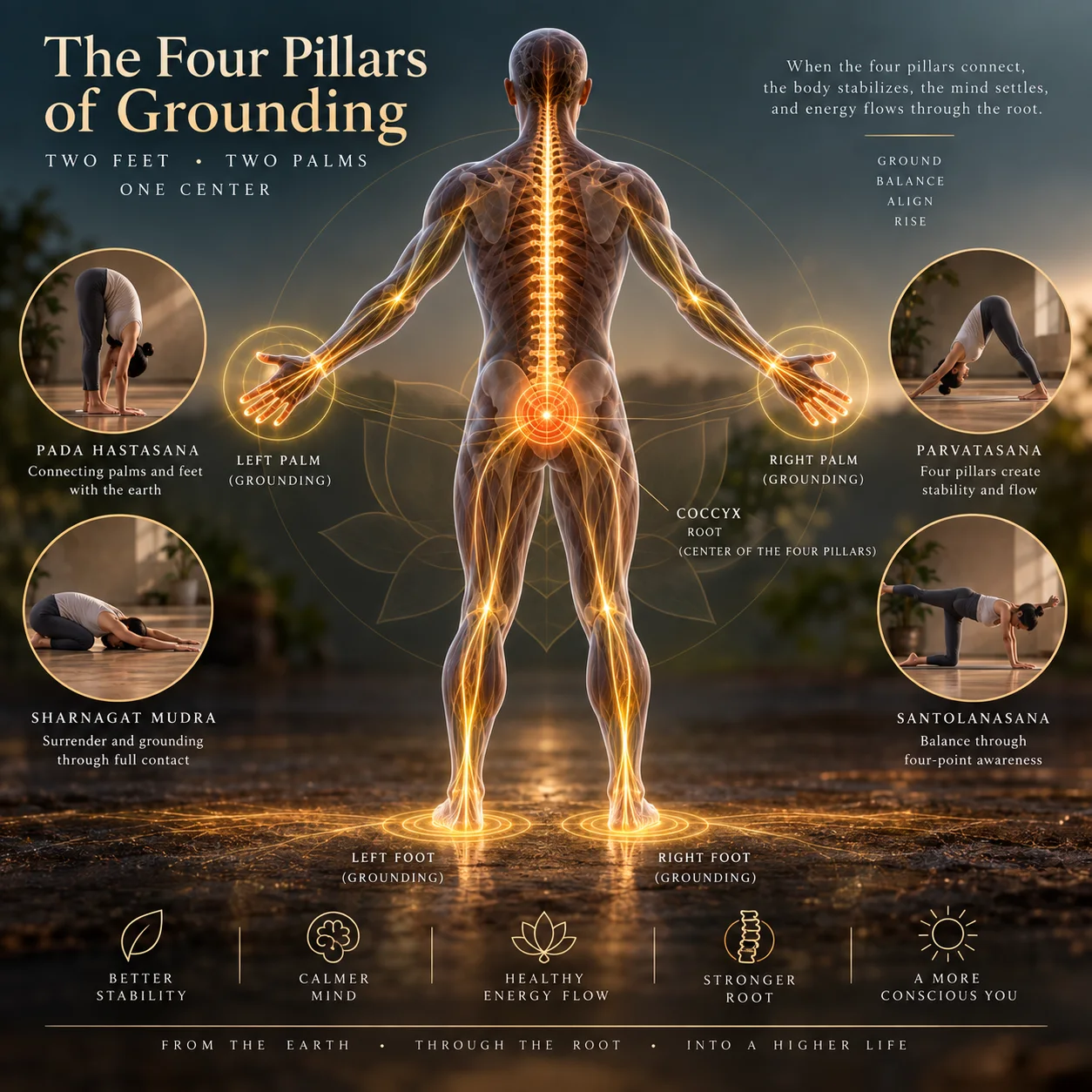
Yoga also contains several postures and mudras that deliberately establish a relationship between the four pillars of the body: two feet and two palms. Examples include Pada Hastasana, Sharnagata Mudra, Parvatasana, and Santolanasana. These practices create a coordinated four-point grounding system.
In this model, the coordination of these four pillars is regulated through the root at the coccygeal region.
The Foot as a Grounding Interface
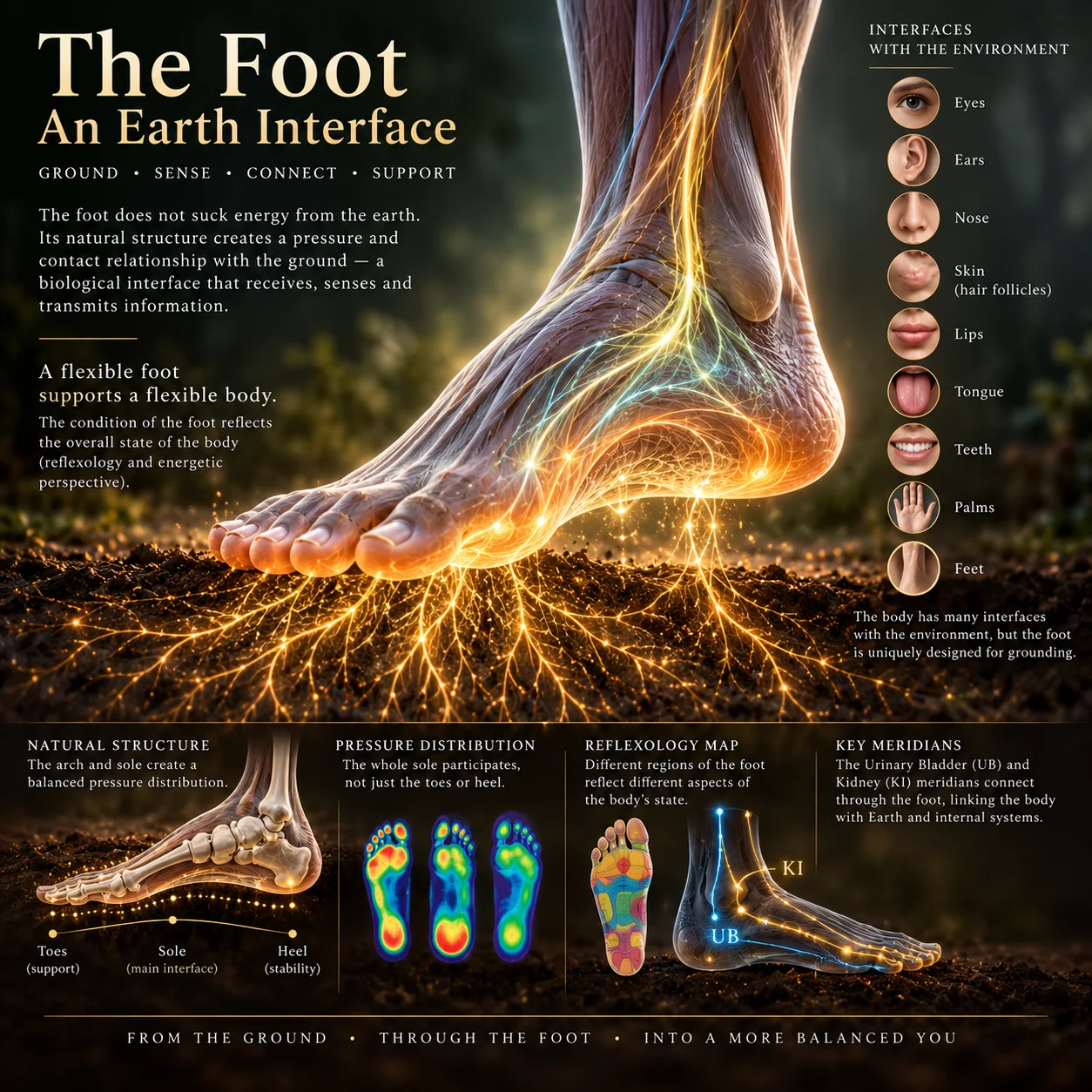
The natural architecture of the human foot is remarkably suited for interaction with the ground.
The sole does not literally suck energy from the earth. Instead, its structure creates a pressure and contact relationship with the ground that can be compared, metaphorically, to a vacuum-like or suction mechanism.
The important interaction is not simply at the toes or the heel. The functional pressure distribution through the sole creates a broader relationship between the body and the ground.
The condition of this interface can also provide information about the condition of the body.
A flexible, responsive foot allows greater adaptability throughout the kinetic chain. In reflexology and related energetic interpretations, different regions of the foot are therefore considered to reflect different aspects of the body's state.
The foot can consequently be viewed as both a terminal point and a sensory interface.
Internal Qi and External Qi
From a TCM perspective, the body is continuously interacting with Internal Qi and External Qi.
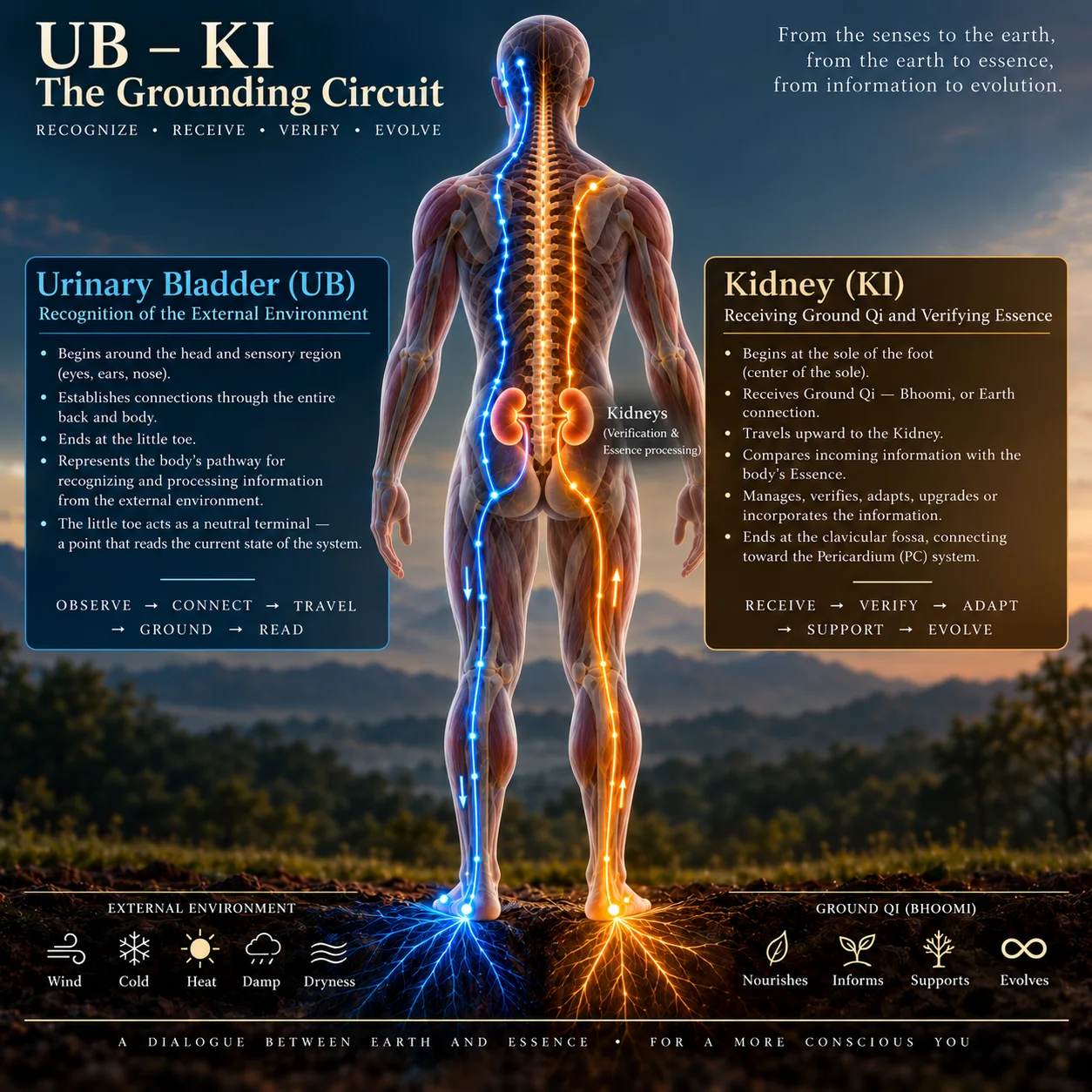
External influences include the classical environmental factors such as:
- Wind
- Cold
- Heat
- Damp
- Dryness
But recognition of the external environment does not belong exclusively to the feet.
The body has many other interfaces through which it perceives and responds to its surroundings:
palms, skin, hair follicles, nose, ears, eyes, lips, tongue, and teeth.
Even so, the foot is biologically the most naturally suited of these interfaces to carry out this task of grounding, and this capacity can also be developed or trained where it is weaker.
When grounding is weak, the problem may be understood conceptually as a disruption in the body's existing Essence, lifestyle imprint, or internal program. The body may have lost, weakened, or corrupted the patterns through which it normally establishes a stable relationship with its environment.
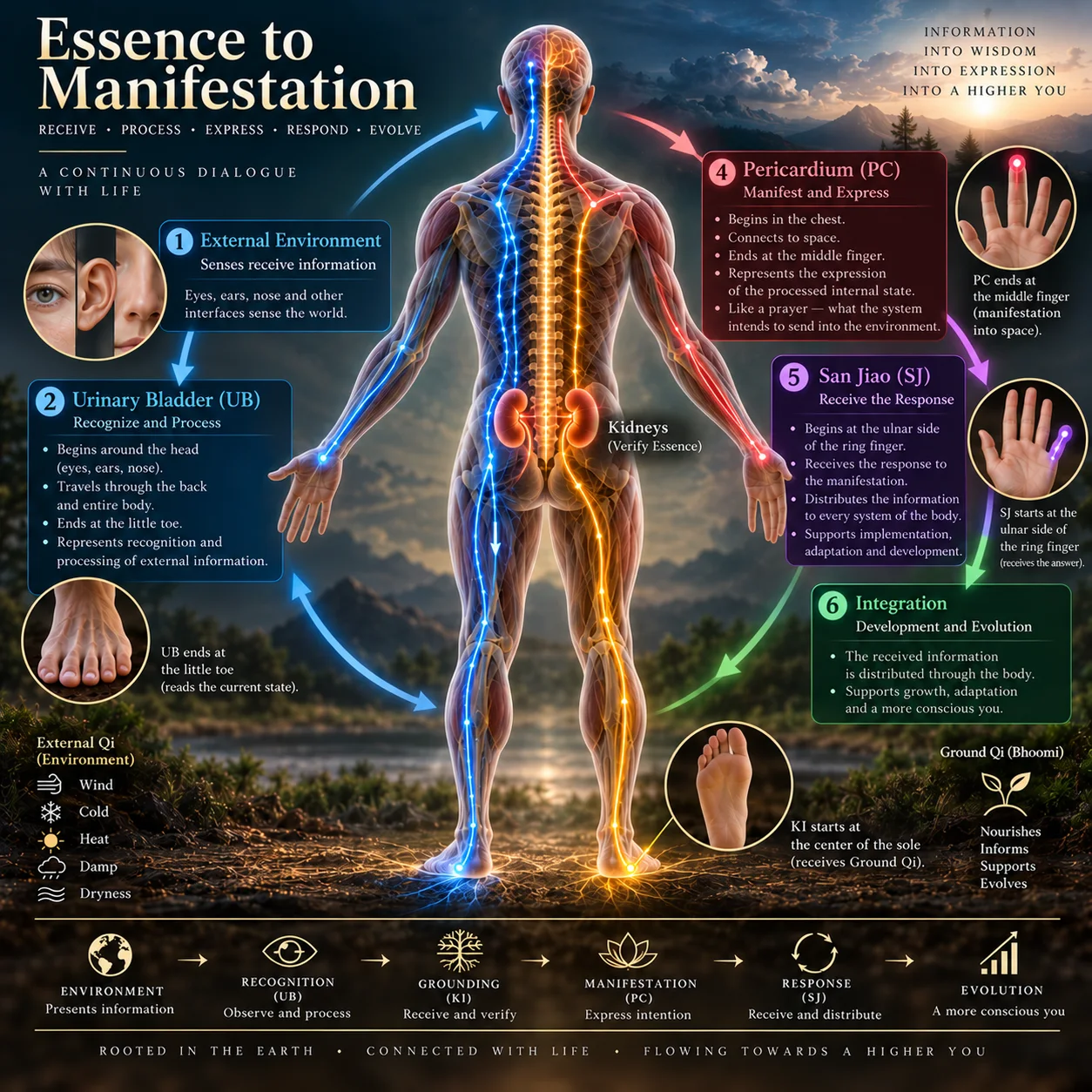
UB: Recognition of the External Environment
Looking at the body's closest sensory interfaces to the brain, we immediately encounter the eyes, ears and nose.
This provides an interesting way to understand the architecture of the Urinary Bladder (UB/BL) meridian.
The UB pathway begins around the head and sensory region, establishes connections through the body, and eventually reaches the little toe.
In this conceptual model, UB represents the body's pathway for recognizing and processing information from the external environment.
Its terminal relationship with the little toe gives the foot another important role.
The little toe can be viewed symbolically as a neutral terminal, a point that reads the current state of the system.
Thus, UB can be understood as a pathway that:
observes → connects → travels through the system → reaches the terminal → grounds and reads the current state.
KI: Receiving Ground Qi and Verifying Essence
The Kidney (KI) pathway provides the complementary architecture.
Its relationship with the sole of the foot is especially significant in this model.
The sole becomes the point where Ground Qi (Bhoomi, or Earth connection) is received into the body.
But the Kidney does not simply receive this information.
The incoming information must be compared with what already exists within the organism: its Essence.
Essence can be understood here as more than a stored biological substance. It represents the accumulated intelligence of the organism, its inherited potential, experience, survival adaptations, and the information that has shaped its development.
Therefore:
Ground Qi enters → Kidney receives → Essence verifies → the system decides whether to maintain, adapt, upgrade, or incorporate the information.
This creates a form of compatibility and qualification process.
The body does not blindly accept everything from the environment. It evaluates incoming information according to what is compatible with its existing state and what may support its future development.
This is where grounding becomes more than contact with the earth. It becomes a process of interaction, recognition, verification and adaptation.
From KI to Pericardium: From Internal Processing to Manifestation
The upward pathway of KI eventually reaches the region of the clavicular fossa.
This creates an interesting transition toward the architecture of the Pericardium (PC).
The Pericardium pathway begins in the chest and travels toward the middle finger.
In this conceptual architecture, the middle-finger endpoint represents a relationship with space and manifestation, which can also be related symbolically to the use of mudra.
Once the external information has been received and processed against the body's Essence, the system can generate an intention or manifest.
The Pericardium therefore becomes the interface through which the processed internal state is expressed outward.
It can be compared to the structure of a prayer:
receive → process → formulate → manifest.
The manifestation is not merely an external action. It is the expression of what the internal system has decided to send into space.
San Jiao: Receiving the Response
The San Jiao (SJ), or Triple Energizer, begins at the ulnar side of the ring finger.
In this model, its relationship with Pericardium creates the next stage of the cycle.
Pericardium sends the manifestation into space.
San Jiao represents the pathway through which the response to that manifestation is received and distributed.
The response can then move through the different systems of the body, allowing the organism to implement, adapt and develop.
This creates a larger cycle:
External environment
↓
UB, recognition
↓
Grounding
↓
KI, receiving and verifying
↓
Essence, compatibility and adaptation
↓
PC, manifestation
↓
Space / environment
↓
SJ, response
↓
Distribution through the body
↓
Development and implementation
The Role of Essence
Within this architecture, Essence becomes particularly important.
Essence is not treated simply as a passive reserve.
It represents the accumulated potential, information, experience and adaptive intelligence of the organism.
The relationship between Essence and External Qi can therefore be understood as a continuous dialogue.
The environment presents information.
The body recognizes it.
The information is grounded and processed.
Essence determines how that information relates to the existing system.
The organism then responds according to its capacity, history and developmental requirements.
In this sense, evolution is not merely an upward movement. It is an ongoing process of interaction between Inner Qi and External Qi.
GV: The Governing Axis
Above and through this entire architecture is the Governing Vessel (GV).
GV can be understood as the central governing axis of the meridian system.
It is the median line, but it is also connected with the broader meridian network.
It sees, connects, binds, supports and guides.
It does not function as an isolated pathway. Rather, it can be conceptualized as the central parent architecture through which the different meridian systems maintain relationship with one another.
In this framework:
GV is the axis that sees everything, connects everything and guides everything.
This is also where the chakra architecture enters the model.
The GV forms the central median axis through the body's chakra system, touching the 13 chakras of the system, extending from the root to the crown.
The chakra points can therefore be understood as stations along the central governing architecture, while GV provides the continuous axis connecting them.
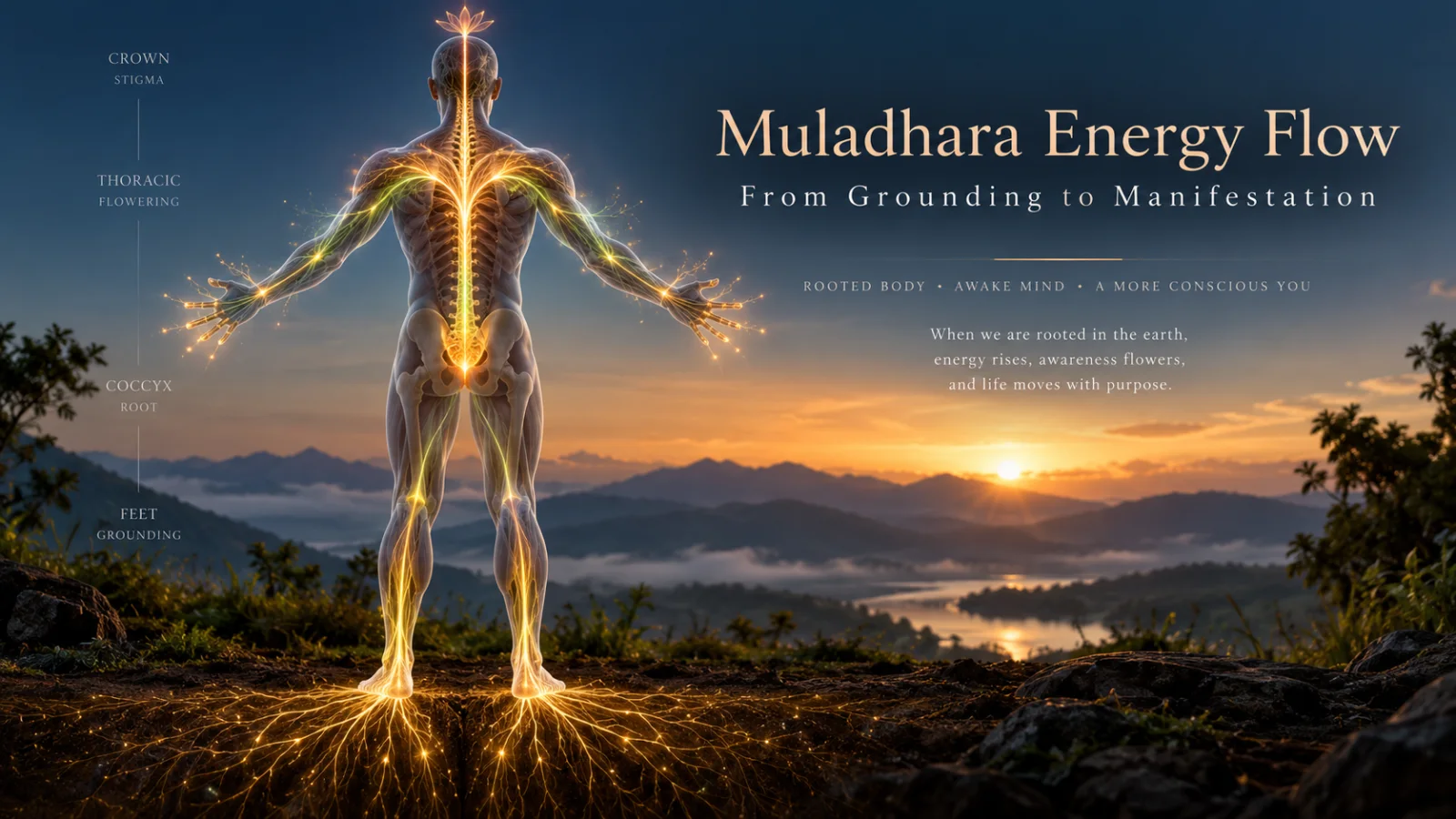
Root to Crown: The Flowering of the System
This brings us back to the original Muladhara model.
The feet establish the root.
The coccyx becomes the root base.
The spine becomes the central stem.
The energy rises through the spinal axis.
At the thoracic/manubrial region, the central flow begins to flower outward, spreading toward the shoulders, arms, hands and fingertips.
At the same time, a much finer central line continues upward through the median axis toward the crown.
The broad flow represents expression and manifestation.
The thin central line represents the refined movement of Essence, intention and governing information toward the crown.
The crown therefore becomes analogous to the stigma of a flower, the final receptive and expressive point of the flowering structure.
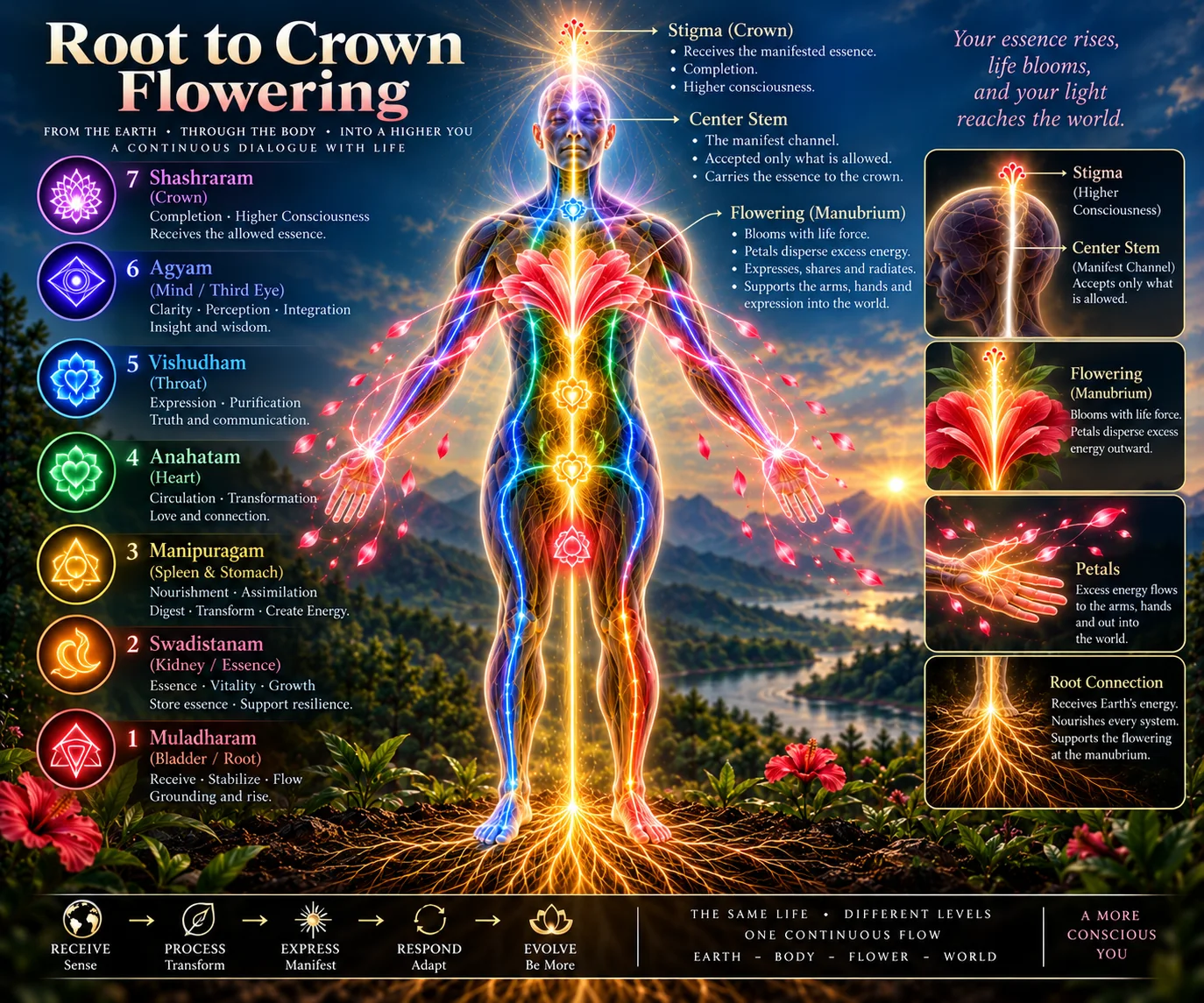
The complete architecture can consequently be represented as:
Earth
→ Feet / Roots
→ Coccyx / Root
→ Spine / Stem
→ Thoracic Centre / Flowering
→ Arms and Fingers / Expression
→ Crown / Stigma
The human body, in this visualization, becomes a living flowering system.
It is rooted in the earth, gathers and evaluates information, organizes it through the central axis, expresses it outwardly, receives feedback, and continuously adapts itself.
The purpose of grounding, therefore, is not simply to remain connected to the earth.
It is to establish a stable relationship between Earth, External Qi, Internal Qi, Essence, manifestation and the governing intelligence of the body.
And the GV provides the central axis through which this entire architecture can remain connected, from Muladhara to Crown.
What did you think?
Be the first to share your thoughts
More to Read

The Only Definition of a Yoga Pose That Actually Matters, According to Patanjali Himself
Sep 26, 2026
The Practice Where You Close Every Gate to the Outside World on Purpose
Sep 25, 2026
The One Seat That Will Not Fight You While You Are Trying to Breathe
Sep 24, 2026
Why the Hands Matter as Much as the Legs in a Meditation Seat
Sep 23, 2026
Sitting in Easy Pose and Actually Meditating in It Are Not the Same Thing
Sep 22, 2026
Boat Pose Is Not an Ab Exercise Wearing a Sanskrit Name
Sep 21, 2026
0 Comments
Share your thoughts. Comments are reviewed before appearing.
Leave a Comment